Winter Storm Fern — When the Schedule Turns into a Moving Target
Winter Storm Fern had been on everyone’s radar well in advance. The entire country knew disruptions were coming, and in the airline world, that usually means proactive cancellations, schedule reshuffles, and a lot of controlled chaos. To the company’s credit, they coordinated early with our codeshare partners and started canceling flights before the weather fully arrived. From an operational standpoint, this is exactly what you want to see — fewer airplanes and crews out of position when the system starts to buckle.
Luckily, I wasn’t scheduled to work on Sunday the 25th, which ended up being one of the worst cancellation days anyway. The ripple effects didn’t really hit me until late Sunday afternoon and into the night, when the notifications started rolling in about changes to my Monday schedule.
Originally, Monday was supposed to be straightforward: an 8 a.m. Nashville turn out of Boston, followed by Boston–JFK to finish the day. I had a strong feeling the Nashville turn would disappear — and sure enough, it did. That leg was removed and replaced with a later Boston–Cincinnati flight instead. The rest of the plan now involved a series of deadheads: Cincinnati to Charlotte and eventually to JFK to pick up the original pairing the following day.
On paper, it looked workable. In reality, the plan started unraveling almost immediately.
Even before I made it to the airport Monday morning, I received another update: my first deadhead segment from Cincinnati was already canceled. I called Crew Scheduling and was told they were aware of it and that I should simply continue operating my assigned flight and wait for further instructions. At that point, the only thing that was still solid was the Boston–Cincinnati leg itself.
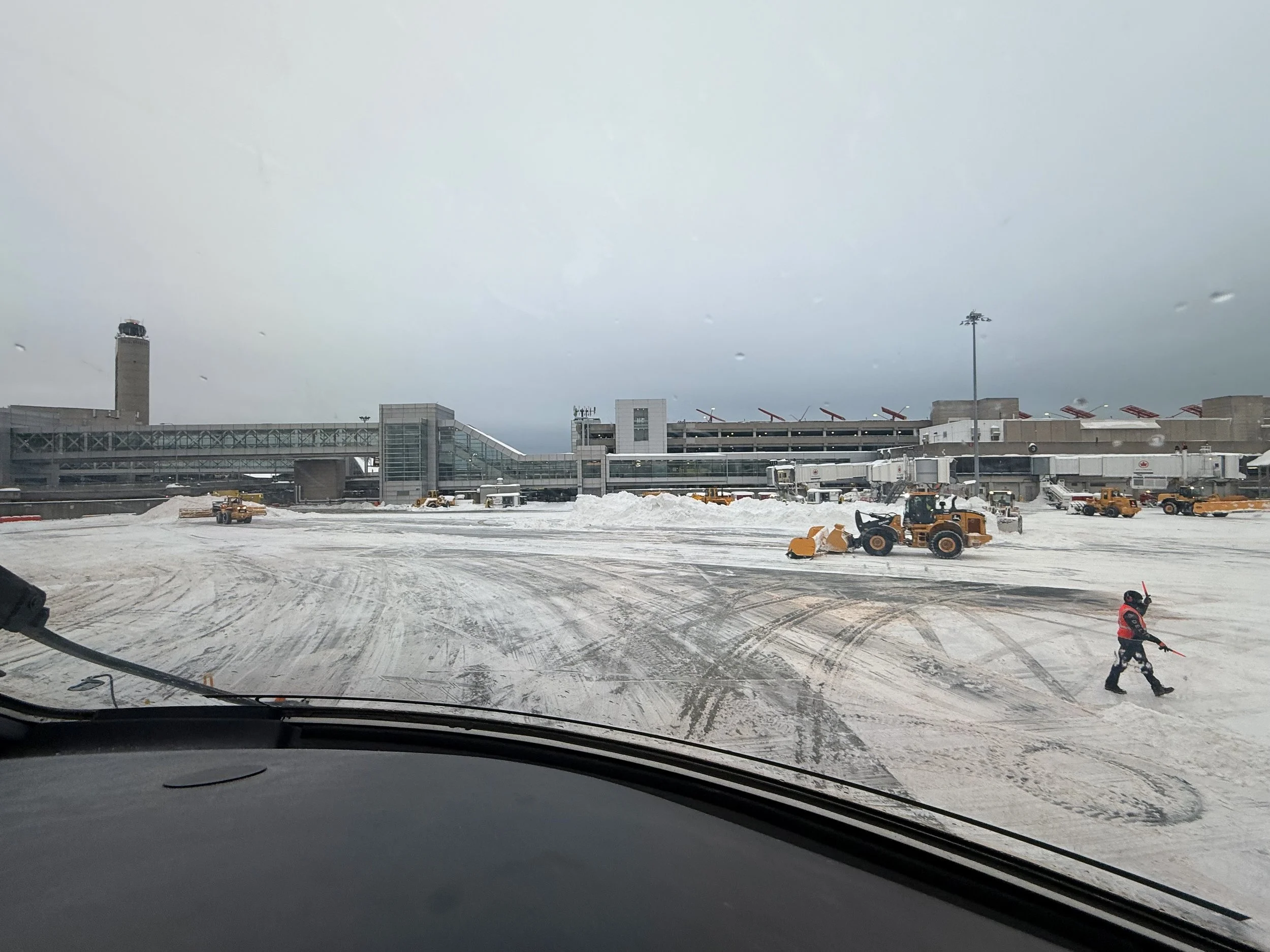
That flight did operate, though not without friction. The inbound aircraft was delayed, snowfall was still ongoing in Boston, minor maintenance discrepancies, and deicing added extra time on the ground. Eventually, we made it to Cincinnati without issue.
Once on the ground, things got interesting again. The captain’s original plan to deadhead back to JFK fell apart as well, as we landed right after his deadhead flight departed. The two flight attendants assigned to our Boston–Cincinnati leg had already been reassigned for Tuesday and had hotel rooms secured. Since there were no viable outbound options for the captain and me to reach JFK that evening, we decided to ride with them to the hotel with no confirmed reservations just yet.
While on the shuttle, crew scheduling called one of the flight attendants to discuss her schedule changes. Since all of us were together, we took the opportunity to talk directly with scheduling one-on-one to sort out what the next day might look like. At that point, the plan I was given was this: I would have a single deadhead from Cincinnati to JFK late the next morning, overnight there, and then resume my original pairing on Day 3 of the trip. The captain would separately operate back toward the East Coast and meet me in New York.
We were lucky that all four of us ended up at the same hotel — no additional shuttles, no scrambling for transportation, just one small logistical win in an otherwise shifting puzzle.
But the story didn’t stop there.
Not long after I got to my room, another update came through. The plan changed again. Instead of deadheading, I was now scheduled to operate Cincinnati–Boston in the morning, then continue operating Boston–LaGuardia afterward, followed by a Lyft ride to JFK.
Then Tuesday morning arrived.
While I was studying for recurrent and getting ready for what was now supposed to be an 11-ish report time, another notification popped up: the Cincinnati–Boston leg had been canceled. At this point, nothing felt stable anymore. I checked the schedule again — and then yet another update came in moments later. The flight wasn’t actually canceled after all; it had simply been renumbered. We were still going to Boston, just under a different flight number.
So that’s where things stood: still going to Boston, just not the way the system originally showed it. So we packed up and headed over to the airport.
While we were walking down the concourse, one of the flight attendants from yesterday’s crew called and told me she had reported for duty at 6 a.m. for a Cincinnati–Boston flight, only to have it delayed… and delayed… all the way until 2 p.m. Eventually, the company sent her crew back to the same hotel we had stayed at. She had just checked back in when she received another notification saying she would now be working with us on this new Cincinnati–Boston flight.
That was the first sign that the day might not be going exactly as planned.
By the time we made it to the gate, things still didn’t feel quite right. I kept refreshing the company scheduling app, where we normally pull our dispatch release — it usually becomes available about an hour before departure — but nothing would load. No release, no updates.
On top of that, when we checked our crew listing, there were no flight attendants assigned on our end at all, which didn’t match what she had just told me. The captain called dispatch to clarify: first, why the release wasn’t showing up, and second, why the crew information was missing. The answer came back quickly and bluntly — this flight had also been canceled.
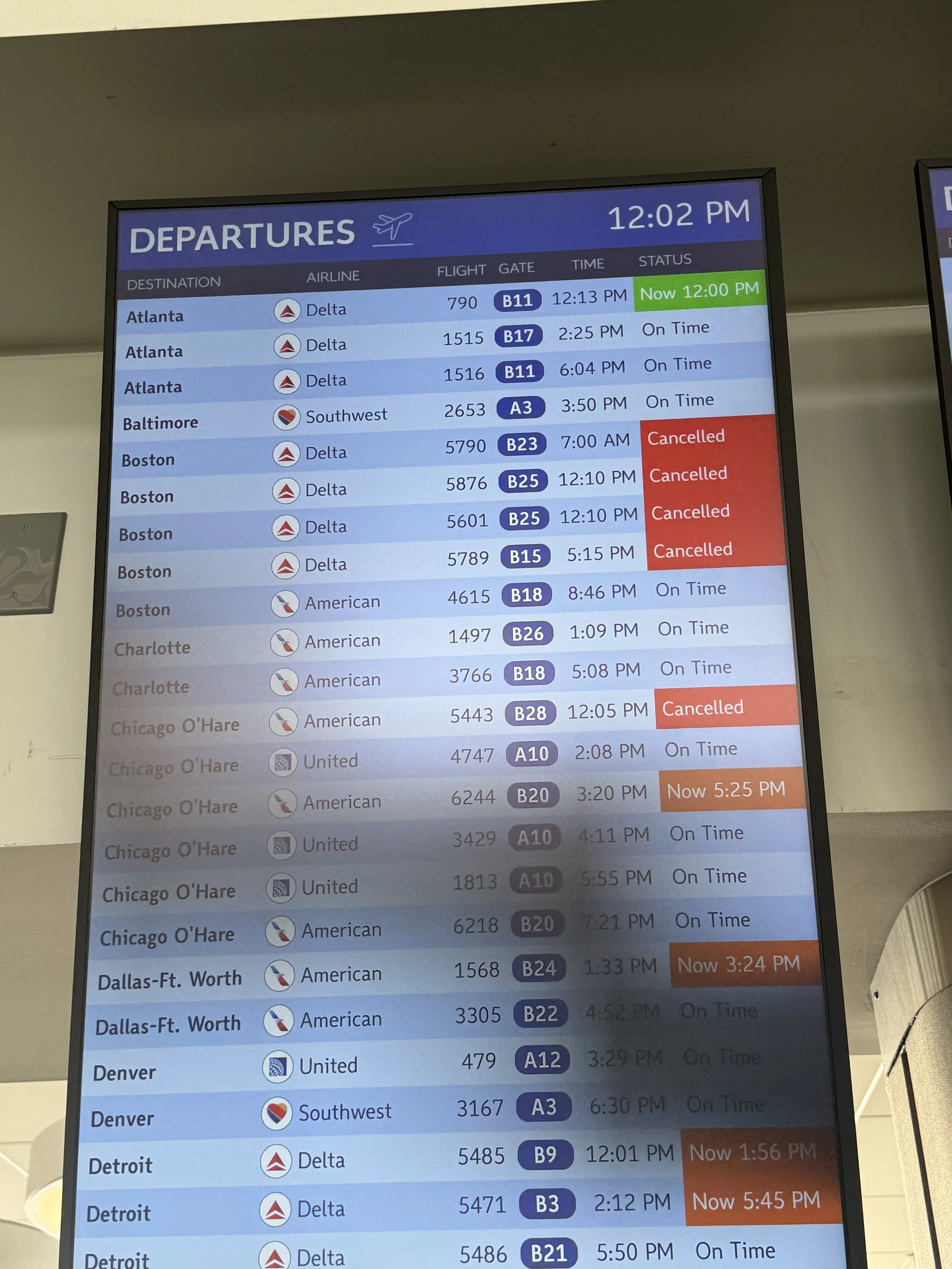
So now we are stuck in Cincinnati, yet again.
With nowhere immediate to be and nothing productive we could do from the gate, we decided to wander the terminal a bit. We checked the Escape Lounge near our gate — completely full. Eventually we made our way over to the Club lounge in Terminal A and settled in there.
I called crew scheduling again. One 197 callers ahead of me. Trying to get clarification from Crew Scheduling has been its own adventure, for good reasons. When I called the night before, I was number 215 in line and didn’t receive a callback until 6:25 a.m. This morning, after the latest cancellation notice popped up, I called again and found myself number 226 in line. That was my cue to hang up and let the system stabilize on its own.
At this point, all we can really do is wait and see what the next plan becomes.
This is what large-scale weather disruptions actually look like from the inside: layers of contingency plans constantly rewritten in real time, pairings reshuffled, crews repositioned like chess pieces, and everyone waiting for the next update. It isn’t chaotic in a dramatic sense — it’s methodical, procedural, and relentless — but it absolutely tests patience and adaptability.
For now, the only certainty is uncertainty. We’ll see what the next notification brings.