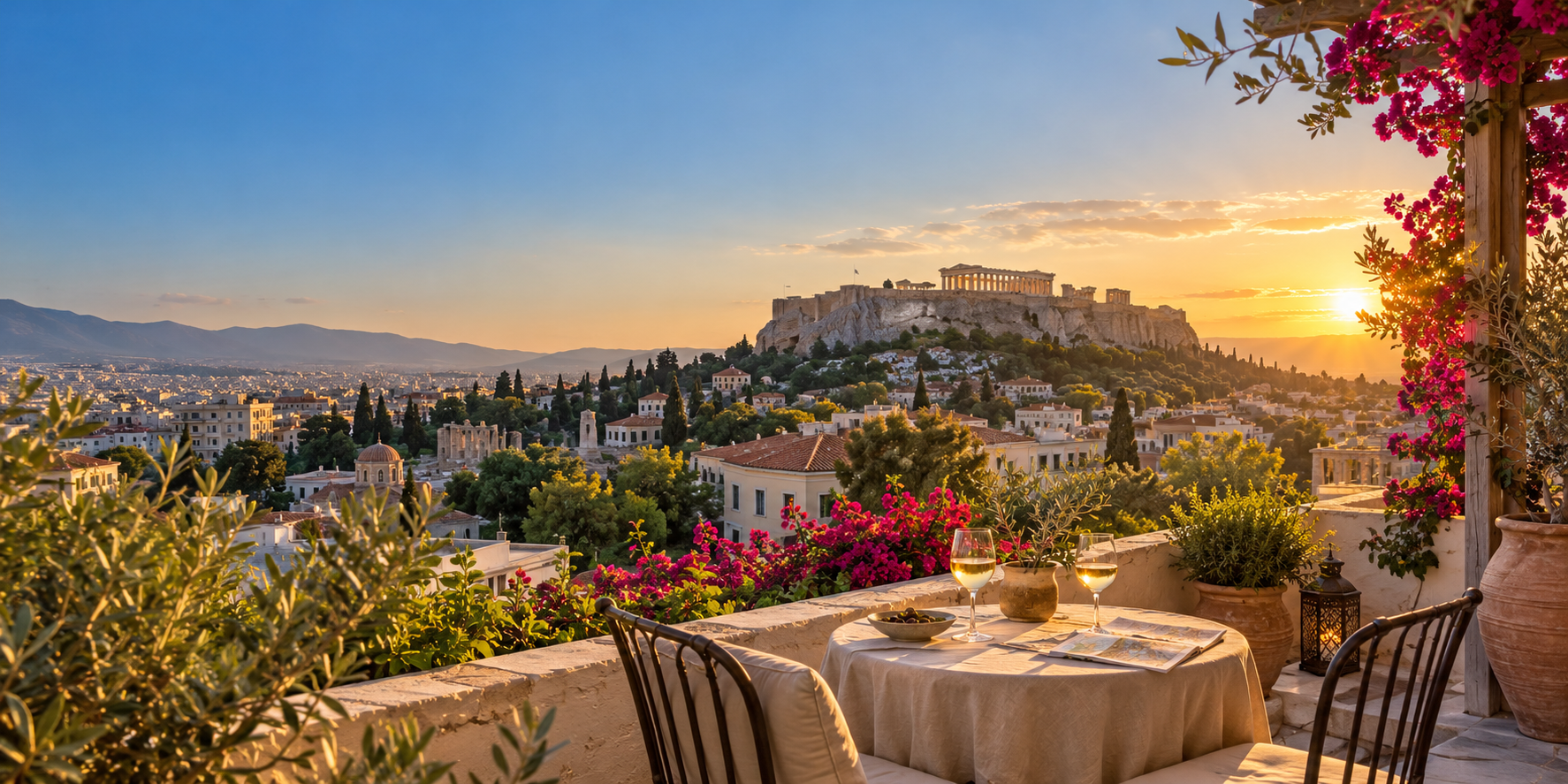
Our Greek
Escape.
20–24 OCTOBER 2026 · GREECE
A little time for us. A detailed guide for two before we go—and a living scrapbook once the memories begin.

October 20–24, 2026
Our Greek Escape
Short, but sweet.
I’ve never believed photographs alone can tell the full story. They capture where we were, but not necessarily what we experienced, the things we learned, or the little moments that made the trip memorable. So bear with my rather lengthy journaling. We wanted to remember more than just the beautiful views.Begin the journalDay 1 — Athens→
Day 1
Tuesday, October 20 · Athens
Our long-overdue vacation to Greece began with a rather enjoyable Delta One flight from Boston to Athens. After months of looking forward to this trip, it felt wonderful to finally be on our way, and the comfortable overnight flight certainly made the journey more pleasant. We were among the first passengers off the aircraft when we landed on Tuesday morning, and getting through immigration was surprisingly quick and straightforward. The immigration officer checking our passports, however, didn't seem particularly pleased to see us, which wasn't exactly the warm Greek welcome we'd imagined. Fortunately, the process itself was smooth, and within a short time, we were making our way through the airport toward the train station.
We'd decided to take the metro into Athens rather than arrange a taxi, partly because it seemed straightforward and partly because we thought it would be a nice introduction to the city. Following the airport signs was easy enough, and we eventually found the railway station and figured out how to purchase our tickets. Naturally, before actually boarding the train, we spent an unreasonable amount of time trying to take a decent picture of each other at the station. We must have taken what felt like a million photographs before finally agreeing that one of them looked acceptable, which was probably an early indication of how much time we'd be spending taking pictures throughout the trip. The train arrived about five minutes later than scheduled, and we settled in for the forty-something-minute ride into central Athens, watching the scenery gradually change as we approached the city.
Our stop was Evangelismos, a name that took us several attempts to pronounce correctly. The Greek language was already proving interesting, particularly with its unfamiliar alphabet and place names that looked considerably more complicated than they sounded once someone actually said them. We eventually got off at the correct station and spent a little more time than expected figuring out which direction to walk toward our hotel, Conrad Athens The Ilisian. Fortunately, it wasn't far, and after a little wandering with our luggage, we finally arrived.
The hotel made an excellent first impression. Conrad Athens had only recently reopened following a major transformation of the former Hilton Athens, a landmark property that had been part of the city's skyline for decades. Everything felt fresh, contemporary, and beautifully designed, and the staff seemed genuinely pleased to show us around. What surprised us most was that our room was already available despite arriving so early in the morning. We'd expected to leave our luggage with the concierge and spend several hours exploring before being able to check in, but instead, we were welcomed into the room almost immediately. We received a tour of the property, admired the facilities, and had a chance to freshen up before heading out. After an overnight transatlantic flight, having somewhere comfortable to settle in for a few minutes was a luxury we hadn't counted on. The hotel also gave us a bottle of champagne, which we decided to save for another occasion, not knowing at the time that it would eventually accompany us all the way to Meteora.
Once we'd dropped off our belongings, we headed out on foot toward the historic center of Athens. We'd planned to spend the day exploring the Acropolis and some of the surrounding attractions, but our first stop was the Panathenaic Stadium, which was conveniently located along our walking route. Originally, we'd intended to admire it from outside, take a few photographs, and continue walking. Once we got there, however, the stadium looked interesting enough that we decided to purchase tickets and go inside. That turned out to be one of the best spontaneous decisions of the day.
The Panathenaic Stadium is remarkable not only for its scale and beautiful white marble but also for the way it connects ancient Greek athletics with the modern Olympic movement. Athletic competitions took place at this location as far back as the fourth century BC, and the stadium was later rebuilt in marble during the Roman period. After centuries of disuse, it was restored in the nineteenth century and became the principal venue for the first modern Olympic Games in 1896. The stadium is sometimes called Kallimarmaro, meaning "beautifully marbled," which seemed entirely appropriate once we were standing inside and looking at the enormous rows of white marble seating surrounding the track.
We spent quite a bit of time exploring the stadium, climbing through the seating areas, walking around its perimeter, and taking photographs from different perspectives. It was fascinating to imagine thousands of spectators gathering in this same space, first for athletic competitions in antiquity and then again when the Olympic Games were revived in the modern era. But one of the most memorable sights had nothing to do with a formal tour or historical monument. There was a group of elementary schoolchildren having what appeared to be their regular physical education lesson on the grounds. Watching them run around and participate in ordinary school activities inside such a historically significant venue was both amusing and strangely touching. For these children, perhaps it was simply another day of PE, while we were standing there marveling at the idea that they were exercising in the stadium where the modern Olympic movement began.
Of course, I couldn't resist the opportunity to run a lap around the track myself. It seemed like something worth doing, if only to be able to say that I'd run at an Olympic stadium. What I hadn't fully appreciated was how tiring it would feel after an overnight flight and a morning of walking. By the time I finished, I was sweating considerably more than I'd expected, although I was still quite pleased with myself. According to Marissa, completing that single lap took approximately three hours, which I maintain is a wildly inaccurate assessment of my athletic performance. Nevertheless, she seemed to enjoy reminding me of it for the rest of the day.
After leaving the stadium, we continued walking toward the National Garden, although we never quite managed the leisurely stroll through the grounds that we'd originally imagined. The garden itself dates to the nineteenth century, when it was developed as part of the royal palace grounds, and today it provides a large green space in the middle of an otherwise densely developed city. We mostly followed the surrounding streets rather than explore the garden in any depth, eventually stopping at a nearby café for something to drink.
That turned into a much longer break than we'd anticipated. The drinks took what felt like an eternity to arrive, and we began joking that perhaps someone had gone out to harvest the ingredients rather than simply prepare our order. Fortunately, the delay gave us time to observe our surroundings, including one particularly unexpected sight: a turtle attempting to cross a busy road. At first, we assumed it must have been someone's escaped pet, because seeing a turtle casually navigating city traffic seemed rather unusual. But as the day progressed, we encountered several more, eventually counting four turtles in total, along with a surprising number of parrots flying around the city. We'd expected Athens to be full of ancient monuments, tourists, and traffic, but we certainly hadn't anticipated encountering so much wildlife in the middle of the capital.
Once our drinks finally arrived and we'd recovered a little from the morning's activities, we continued toward the Acropolis. By now, we'd already spent several hours exploring, and the weather had been remarkably pleasant. The sun was warm without being overwhelming, while the shaded streets remained comfortably cool, a combination that made walking around the city particularly enjoyable. We entered the archaeological site through the South Slope entrance, waited briefly in line, and began following the paths uphill toward the Parthenon.
One of the first major structures we encountered was the Theatre of Dionysus, built into the southern slope of the Acropolis. I knew that ancient Greece had made enormous contributions to theater and drama, but standing in front of the remains gave that history a much more tangible quality. This was one of the places where Greek tragedy and comedy developed into the theatrical traditions that continue to influence literature and performance today. Playwrights such as Aeschylus, Sophocles, Euripides, and Aristophanes had their works performed here during festivals honoring Dionysus, the god associated with wine, fertility, and theater. It's interesting to think that performances in ancient Athens weren't simply entertainment in the modern sense; they were also important civic and religious occasions, bringing people together to reflect on questions involving morality, power, family, and human behavior. Looking at the surviving stone seating, it was remarkable to imagine an audience gathering here more than two thousand years ago to experience stories that are still studied and performed around the world.
From the theater, we continued climbing toward the upper Acropolis, gradually making our way through the ancient ruins until the enormous columns of the Parthenon came into view. We'd both seen countless photographs of the structure, but seeing it in person was considerably more impressive than we'd expected. The building was enormous, and the surviving columns seemed even more massive against the surrounding sky. There was something extraordinary about standing beside a structure that had endured nearly two and a half millennia of history, particularly when considering how much of that history had unfolded after its original construction.
The Parthenon was built in the fifth century BC, during the period often regarded as the height of classical Athens, and was dedicated to Athena, the city's patron goddess. It was both a religious monument and a powerful expression of Athenian wealth, confidence, and cultural achievement. Over the centuries, the building served different religious purposes, suffered damage through warfare and neglect, and underwent repeated efforts at preservation and restoration. One of the most devastating events occurred in 1687, when an explosion during a Venetian bombardment destroyed much of the structure. Knowing that history made the surviving architecture seem even more remarkable, although at the time, we were mostly occupied with admiring how enormous everything looked and trying to capture it in photographs.
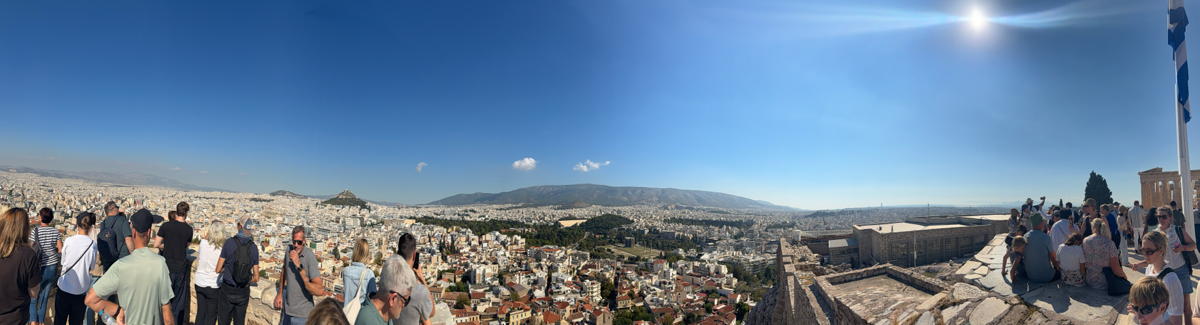
We spent a good amount of time walking around the summit, looking at the Parthenon and the other ancient structures, including the Erechtheion with its famous Caryatid figures. From the top, we could see Athens stretching across the landscape in almost every direction, an enormous expanse of buildings surrounded by mountains. It was difficult to reconcile that modern city with the relatively small collection of ancient monuments beneath our feet, particularly when thinking about how influential Athens had once been in shaping ideas about politics, philosophy, art, and education. We kept stopping to admire different views, taking photographs of the ruins and the city below, and occasionally simply looking around without saying much because the setting was so impressive.
We also FaceTimed the girls while we were up there, partly because we wanted to show them where we were and partly because we thought it would be funny to remind them what a wonderful time we were having without them. We jokingly showed off the ancient ruins and the beautiful scenery, making sure they understood exactly what they were missing. Parenting at its finest, apparently. Of course, we also found ourselves imagining how they might have reacted if they'd actually been there with us, although after all the walking and climbing we'd already done, I wasn't entirely convinced that bringing two young children up the Acropolis would have been quite as relaxing as our little video call made it seem.
Eventually, we decided we'd seen enough and began making our way down from the Acropolis. Unfortunately, leaving the archaeological site turned out to be considerably less straightforward than we'd anticipated. Somehow, we followed a path that seemed perfectly reasonable at first but eventually led us in entirely the wrong direction. We kept walking, assuming it would eventually connect to the streets below, only to discover after approximately half an hour that we'd reached a dead end. There wasn't much we could do except turn around and retrace our steps, which was particularly frustrating after we'd already spent so much time walking uphill and downhill throughout the morning.
Marissa was becoming increasingly hungry by this point, and our leisurely historical exploration was beginning to feel more like an endurance exercise. I was still trying to figure out where we'd gone wrong, while she was understandably more concerned about finding somewhere to eat. We eventually made our way back toward the surrounding neighborhoods, where the narrow streets were filled with little souvenir shops, cafés, and restaurants. It was nice to be back among the activity of the city, even if we'd taken a rather unnecessary detour to get there.
We spent some time browsing the souvenir shops while searching for food, although much of the merchandise looked rather cheap and touristy. There were endless variations of miniature ancient monuments, magnets, decorative objects, and assorted souvenirs that seemed designed primarily to remind visitors they'd been to Greece. Naturally, despite our less-than-enthusiastic assessment of the merchandise, we still managed to buy something. We also noticed an unexpectedly prominent theme involving male anatomy, both in the form of graffiti on walls and novelty items displayed in the shops. There were an astonishing number of penis-shaped bottle openers and other souvenirs, enough that we began wondering whether we'd somehow missed an important cultural explanation.
Interestingly, phallic imagery did have symbolic significance in parts of the ancient Greek world, where it could be associated with fertility, protection, and good fortune, rather than being viewed exclusively through the sexual or humorous associations we might make today. That historical background doesn't necessarily explain the abundance of novelty bottle openers being sold to modern tourists, but it did make the whole phenomenon a little more interesting. Mostly, though, we just found it funny how often we encountered the same theme while walking through the city. It certainly wasn't something we'd expected to remember from our first day exploring the birthplace of Western philosophy.
After finally finding somewhere to eat and giving Marissa a much-needed opportunity to recover from the combination of hunger and unnecessary walking, we began heading back toward Conrad. Rather than retrace exactly the same route we'd taken earlier, we found ourselves walking through a different part of Athens, passing an area with numerous foreign embassies and impressive institutional buildings. The streets felt quieter and more formal than the crowded historic neighborhoods we'd just left, offering another glimpse of the city's character. We didn't make it to the Parliament building itself, despite passing through the broader diplomatic district, but by then we'd already seen enough for one day and were mainly focused on getting back to the hotel.
By the time we finally arrived at Conrad, we were ready for some serious relaxation. We'd spent most of the day on our feet, climbed around an Olympic stadium, explored the Acropolis, wandered through several neighborhoods, and somehow added an entirely unnecessary half-hour walk to nowhere. We changed into more comfortable clothes and headed downstairs, hoping to enjoy the hotel's beautiful outdoor swimming pool. Unfortunately, it was closed, which was particularly disappointing given how pleasant the weather had been throughout the day.
The indoor pool was available, but the water turned out to be much colder than either of us wanted, and there wasn't a hot tub to retreat to. After briefly considering our options, we decided to spend some time in the sauna instead. That was considerably more enjoyable, although the combination of warmth, accumulated fatigue, and a long day of sightseeing almost put us both to sleep. We eventually dragged ourselves back upstairs, showered, and returned downstairs for a drink at the lounge.
Later in the evening, we found ourselves outside near the poolside lounge chairs, which turned out to be one of the nicest places to relax at the hotel. The weather was still beautiful, the surrounding views were lovely, and the atmosphere was much quieter than the streets we'd spent the day exploring. There were also several cats wandering around the property, although they didn't seem particularly interested in making friends with us. We attempted to interact with them, but they clearly had their own priorities and weren't especially impressed by our presence.
Sitting there, finally able to relax without worrying about where we needed to walk next, it began to feel like the vacation we'd been looking forward to for so long. We'd managed to accomplish an extraordinary amount on our first day, particularly considering we'd arrived that very morning after an overnight flight. Not everything had gone according to plan, and we'd certainly underestimated how much walking we'd end up doing, but some of the most enjoyable experiences had been things we hadn't originally intended to do. Going inside the Panathenaic Stadium was one of them, as was discovering the turtles and parrots around Athens. Even our navigational mistakes and the ridiculous souvenir shops had given us stories we'd probably remember long after the trip.
By the time we eventually returned to our room, we were completely exhausted and more than ready for bed. It had been a full day of ancient monuments, Olympic history, beautiful architecture, unexpected wildlife, questionable souvenirs, and a surprising amount of physical activity. But more than anything, it had been the beginning of something we'd both needed for a long time: an opportunity to step away from our usual routines, explore somewhere unfamiliar, and simply spend time together. We'd only been in Greece for a day, but we were already beginning to appreciate how much the country had to offer, and we still had several days of exploring ahead of us.
What We Originally Planned
Tuesday, October 20 — Athens
Our first-day approach: Airport metro → hotel → a scenic walk through Athens → Acropolis → wander Plaka → Greek dinner → taxi back. Times were suggested, not reservations; the Conrad stay was confirmed, but sightseeing tickets had not been confirmed.
7:35–8:45 AM · Arrival — Land at Athens International Airport, allow time for passport control, baggage, and arrivals.
~8:45–9:55 AM · Metro — Take Metro Line 3 toward Dimotiko Theatro from the airport to Evangelismos, with no transfers. Follow Trains/Metro upstairs and across the bridge; choose the metro rather than the suburban railway. Contactless Visa, Mastercard, Apple Pay, or Google Pay was expected to work, one card or device per person, or buy two €9 tickets and retain them. Exit at Evangelismos toward Vasilissis Sofias/National Gallery. Estimated fare: €18 total.
~10:00–10:30 AM · Hotel — Drop bags at Conrad Athens The Ilisian, Leoforos Vasilissis Sofias 46, and ask about early check-in.
~10:30–11:00 AM · Panathenaic Stadium — Walk 15–20 minutes along Vasilissis Sofias and Vasileos Konstantinou; admire the stadium from outside and skip the paid interior.
~11:00–11:30 AM · National Garden & Zappeion — Cross from the stadium and follow the palm-lined paths toward the Zappeion and Vasilissis Amalias.
~11:30 AM–12:00 PM · Temple of Olympian Zeus & Hadrian’s Arch — View both monuments from outside.
12:00–1:15 PM · Lunch — Have a slow Greek lunch near Lysikratous Street: gyros, souvlaki, or salad. Not booked.
2:00–4:00 PM · Acropolis & Parthenon — Enter through the western side and visit the Propylaea, Parthenon, Erechtheion, Temple of Athena Nike, and city viewpoints. The 2 PM timed entry was proposed, not reserved; arrive 20 minutes early and take care on the slippery marble. Suggested price: €30 per adult.
~4:10–5:20 PM · Acropolis Museum — Optional; visit the Caryatids, sculpture galleries, and Parthenon Gallery, or move this to Wednesday if tired. Separate ticket expected to be €20 per adult.
~5:30–6:45 PM · Anafiotika & Plaka — Wander the whitewashed lanes and historic streets while respecting the residential areas.
~7:00–8:30 PM · Dinner — Choose a traditional Plaka taverna; Taverna Platanos was a candidate, subject to opening hours and table availability.
~8:30–9:00 PM · Return — Use Uber or FREENOW from a vehicle-accessible street, confirm the pickup and plate, and taxi back to Conrad. Estimated fare: €10–15.
Day 2
Wednesday, October 21 · Athens and Cape Sounion
Wednesday began considerably later than we'd originally intended, although after everything we'd managed to squeeze into our first day in Athens, neither of us felt particularly guilty about sleeping in. According to my phone, I'd slept for nearly twelve hours, despite waking up a few times during the night, and the next thing I knew, it was already after nine in the morning. Apparently, the combination of an overnight flight, an Olympic stadium, the Acropolis, and several unnecessary miles of walking had finally caught up with us. We headed downstairs for breakfast at Conrad, returned to the room to get ready, and arranged an Uber into the historic center for another day of exploring Athens.
Our original plan had been to visit the Acropolis Museum, which we'd missed the previous afternoon, but somewhere between getting ready and riding into the city, we realized that neither of us was particularly enthusiastic about spending the morning looking at rooms full of ancient sculptures. We'd enjoyed seeing the actual Acropolis and wanted to continue experiencing the historical sites themselves rather than spend too much time indoors. So, while we were already in the Uber, I changed our destination to the Ancient Agora instead. It was another spontaneous adjustment to our itinerary, although by this point we were becoming fairly comfortable with the idea that our plans were more suggestions than obligations.
The driver dropped us near a charming stretch of narrow streets lined with little shops, and we enjoyed wandering through them on our way to the archaeological site. Once we reached the entrance, I attempted to purchase tickets online, which turned out to be unnecessarily frustrating. The website refused to process my payment despite trying three different credit cards, so we eventually gave up and joined the regular ticket line, where everything worked without any trouble. It's rather ironic that we can navigate an unfamiliar city, arrange transportation, and communicate across languages almost effortlessly using our phones, yet something as simple as purchasing admission to an archaeological site can still become a technological challenge.
Once inside, we began to appreciate how different the Ancient Agora was from the Acropolis we'd visited the previous day. While the Acropolis represented much of the religious and monumental identity of classical Athens, the Agora was where a great deal of the city's everyday public life unfolded. It functioned as a marketplace, but it was also a place where people gathered, conducted business, discussed politics, and participated in the institutions that shaped Athenian society. Ancient Athens is often remembered for its philosophers, temples, and contributions to democracy, but those ideas weren't developed in isolation from ordinary life. They emerged within a city where public discussion and civic participation were woven into the spaces people used every day, although it's worth remembering that not everyone living in Athens enjoyed the same political rights. Walking through the Agora gave us a somewhat more tangible impression of that world.
Our first major stop was the Stoa of Attalos, an enormous two-story building with long rows of columns that looked considerably more complete than most of the surrounding ruins. We learned that the original structure had been built in the second century BC as a gift from Attalos II, the king of Pergamon, who had studied in Athens. I thought that was an interesting gesture, particularly since what he gave the city was essentially an elaborate commercial building where people could shop, gather, and socialize. The building we walked through was actually reconstructed in the 1950s, which explains why it looked so well preserved compared with everything around it. In a way, that reconstruction made the experience more meaningful because, rather than trying to imagine an entire building from a few surviving foundations, we could actually walk through its colonnades and appreciate the scale and organization of the original structure.
We explored both floors, stopping to look at displays of ancient sculpted heads, architectural fragments, pottery, and other objects recovered from the area. There was also an indoor exhibition downstairs with artifacts illustrating different aspects of ancient Athenian life. Ironically, after deciding we weren't particularly interested in spending the morning at the Acropolis Museum, we'd found ourselves looking at historical exhibits anyway, although the reconstructed building and its relationship to the surrounding archaeological site made the experience more interesting than we'd anticipated.
From there, we continued wandering through the Agora, passing foundations and scattered remains of buildings that had once formed the center of Athenian civic and commercial activity. Eventually, we made our way up to the Temple of Hephaestus, which turned out to be my favorite part of the visit. Dedicated to the Greek god associated with metalworking and craftsmanship, the temple dates to the fifth century BC and is one of the best-preserved ancient Greek temples still standing. It looked like a smaller version of the Parthenon we'd visited the day before, but considerably more of its original structure remained intact, including substantial portions of the walls and columns. Part of the reason it survived so well is that it was later converted into a Christian church, allowing the building to remain in use and receive some degree of maintenance long after its original religious purpose had disappeared. Having seen both temples within twenty-four hours, the comparison was particularly interesting. The Parthenon impressed us with its enormous scale and dramatic location, while the Temple of Hephaestus gave us a clearer sense of what an ancient Greek temple might actually have looked like as a complete building.
As much as we enjoyed the Agora, I kept wishing there were better ways to visualize how the entire complex had looked when it was functioning. We walked past numerous foundations and fragments of walls, but it was often difficult to understand what the buildings had originally been used for or how the different spaces connected. A few well-designed illustrations, a reconstruction drawing, or even some sort of digital overlay would have made the experience much richer. I realize that archaeologists have spent generations studying these remains and that much of the information is available somewhere, but it wasn't always easy to connect that knowledge with what we were actually seeing. The Stoa of Attalos was a good example of how much easier it becomes to understand history when you can experience the dimensions and organization of a space rather than simply look at its foundations. Nevertheless, we enjoyed exploring the grounds, taking photographs, and imagining the generations of people who had walked through the same area over two thousand years ago.
Near the exit, Marissa spotted some jewelry she really liked, so naturally we stopped to buy it before continuing through another series of picturesque streets lined with shops and restaurants. We were beginning to appreciate this part of Athens as much for its atmosphere as for its historical attractions. There were little storefronts everywhere, some selling the usual tourist souvenirs and others offering clothing, jewelry, and handmade items. We browsed without much intention of buying anything else, enjoying the narrow streets and the constant movement of people from different parts of the world.
We had booked an afternoon excursion to Cape Sounion and wanted something quick to eat before meeting the tour group, so we headed toward a small souvlaki shop we'd found online. It was surprisingly busy for such a tiny place, although much of the congestion seemed to come from the fact that only two people were running the entire operation. One person was cooking while the other handled payments and assembled the orders, and between them they somehow kept the line moving. We managed to get our food with enough time to reach the tour pickup, which was all we really needed. By this point, souvlaki was becoming one of our more reliable culinary discoveries in Greece, and I was perfectly happy to keep eating it whenever we needed something quick and satisfying.
Unfortunately, our afternoon plans became a little more complicated when we discovered that the tour company had changed the pickup location. Apparently, a demonstration was expected in central Athens, and the operator was concerned about possible road closures that could interfere with the departure. We'd originally been instructed to meet outside NEW Hotel, and although the company had sent updated directions, we hadn't fully appreciated the change until we were already making our way there. Suddenly, we realized that the revised meeting point was about eight minutes away and we had only a few minutes remaining before our scheduled check-in. What had been a leisurely afternoon of exploring and eating souvlaki quickly turned into another hurried walk through Athens. Fortunately, the minibus hadn't departed when we arrived, and the staff were still waiting for the group. After collecting a few additional passengers, we finally left the city and headed south along the coast.
Our tour guide, Faye, introduced us to the Athens Riviera as we drove through the coastal suburbs toward Cape Sounion. It was interesting how quickly the atmosphere changed once we left the denser parts of Athens. The apartment buildings gradually gave way to seaside neighborhoods, marinas, beaches, and views of the Aegean, offering an entirely different impression of the metropolitan area. We'd spent most of our time in Athens surrounded by ancient buildings and crowded streets, so it was refreshing to see how closely the city was connected to the coastline. We could easily imagine people living in these neighborhoods and enjoying the sea as part of their everyday lives, rather than having to travel far away for a beach vacation.
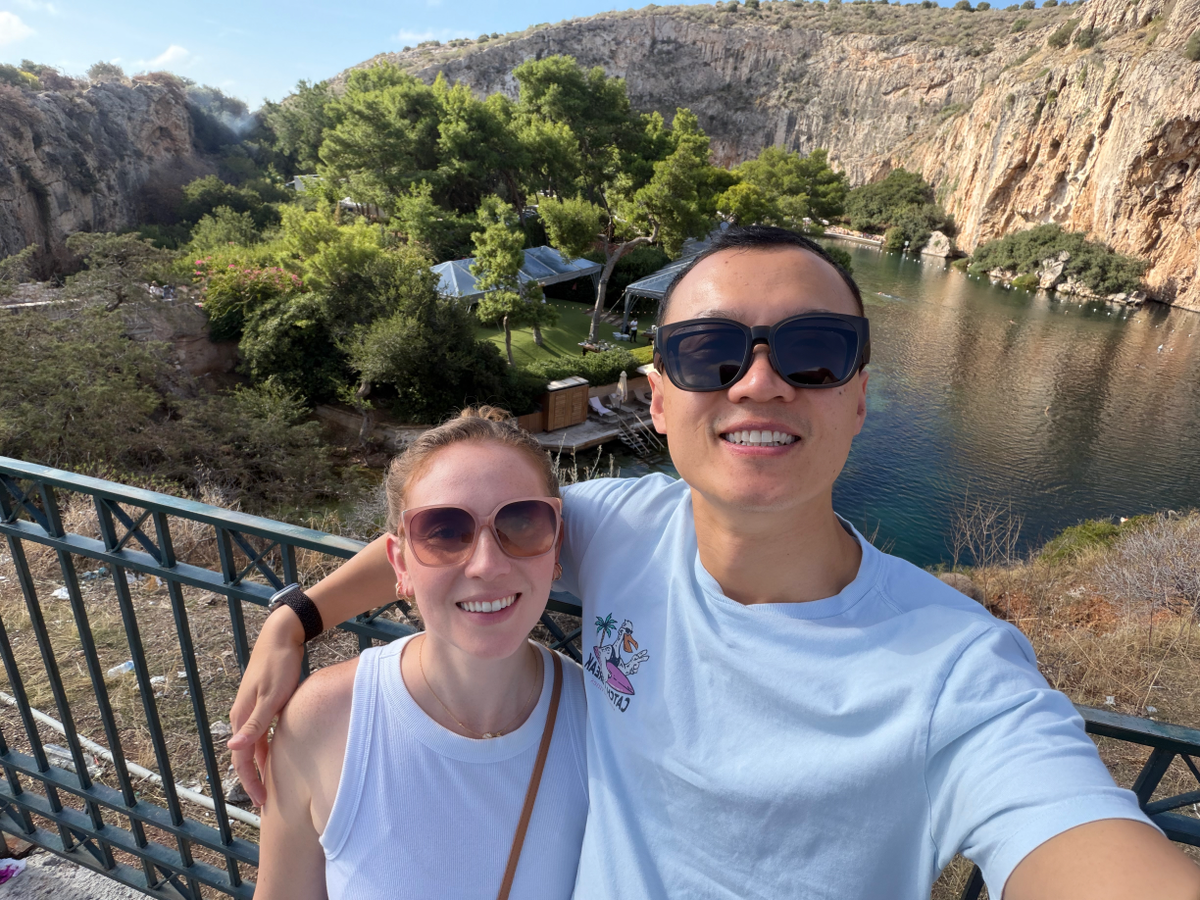
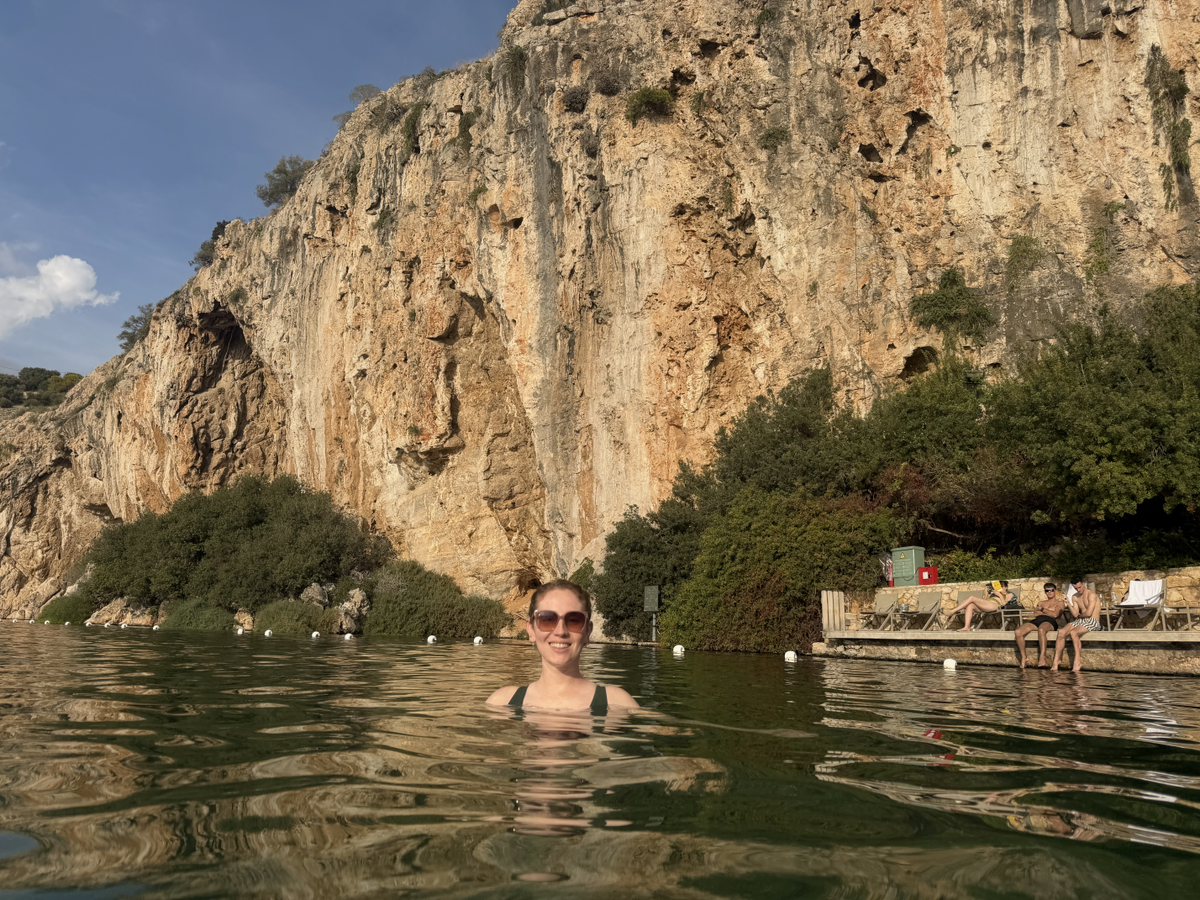
One of our first stops was Lake Vouliagmeni, a beautiful natural lake nestled beneath limestone cliffs near the coast. Faye explained that the lake had formed when part of an underground cave system collapsed and that its water was replenished through a combination of thermal springs and connections with the sea. She also told us that the water temperature remains relatively stable throughout the year, generally somewhere between 22 and 29 degrees Celsius, which sounded particularly appealing. The setting was gorgeous, with clear turquoise water surrounded by rocky formations, lounge chairs arranged beside the shore, and a bar overlooking the lake. There were people swimming and relaxing in the sunshine, and the whole place looked like somewhere we could happily spend an entire afternoon.
We also learned about the little fish that apparently gather around swimmers and nibble at dead skin, providing something resembling a natural pedicure. I wasn't entirely sure what to make of that, but it certainly sounded interesting. Unfortunately, our tour only allowed enough time to admire the lake from above, and we both wished we could have gone down to swim and relax for a while. It looked like such a pleasant place, particularly with the beautiful weather we'd been enjoying. We made a mental note that if we could find enough time before leaving Greece, we'd like to come back and experience it properly.
We continued south along the coast and eventually stopped at a beach bar, where the group was given a little over an hour to relax, have something to drink, or grab a bite to eat. We found some lounge chairs and settled in, enjoying the sea views and the opportunity to do absolutely nothing for a little while. I wandered down along the shoreline hoping to find some interesting seashells to bring home for Ella and Charlie, but unfortunately came away empty-handed. There weren't any particularly appealing shells, although I enjoyed walking beside the water and looking out across the coast.
The drinks we ordered were another matter. They were so disappointing that I didn't even finish mine, which seemed especially unfortunate given how nice the setting was. Before getting back on the bus, I also had to go searching for another bathroom because the first one I found didn't have toilet seats. I'm not entirely sure why this was becoming a recurring feature of our Greek experiences, but after locating a more suitable option, I managed to rejoin the group without causing any further delays. We eventually got back on the minibus and continued toward Cape Sounion.
As we approached the southern tip of the Attica peninsula, we stopped briefly at a scenic viewpoint where we could see the Temple of Poseidon in the distance. The coastline was beautiful, but the temple itself appeared so small against the surrounding landscape that it was almost impossible to appreciate it in our photographs. We took a few pictures anyway before continuing toward the archaeological site, where we finally had an opportunity to see the structure up close.
Cape Sounion is an extraordinary location for a temple dedicated to Poseidon, the Greek god of the sea. The surviving temple dates to the fifth century BC, around the same period as the Parthenon, and stands high above the Aegean on a rocky headland that has served as a recognizable landmark for sailors for thousands of years. The location also figures prominently in Greek mythology through the story of King Aegeus, who, according to tradition, threw himself into the sea after mistakenly believing that his son Theseus had died. The story is associated with the naming of the Aegean Sea, although, like many ancient myths, it's better understood as part of the cultural imagination than as a literal historical explanation. Knowing a little about these stories added another dimension to the experience, especially when standing above the water and looking out toward the horizon.
When we arrived, there appeared to be some sort of formal event taking place, with quite a few people dressed in suits walking around the site. We never figured out what the occasion was, but it made the atmosphere slightly different from what we'd expected. There were also plenty of other visitors who, like us, had come to see the temple and watch the sunset. Fortunately, the archaeological area was relatively small, and the little over an hour we'd been given was more than enough time to explore it without feeling rushed.
After walking around the temple and taking photographs, we found a quieter spot near the rocky edge of the headland, away from most of the crowds. We sat down together and waited for the sunset, enjoying the view over the water and watching the light gradually change. The sun was expected to set around 6:40, but as the evening progressed, clouds began moving across the western sky. We could see the sunlight becoming softer and the horizon gradually disappearing behind the clouds, and it was increasingly obvious that we probably weren't going to get the unobstructed sunset we'd imagined.
By around 6:25, we decided there wasn't much point continuing to sit there hoping the clouds would clear, so we got up and explored farther down the cape instead. That turned out to be a good decision. We walked down toward the end of the headland, enjoying a different perspective of the coastline and the sea, and eventually found a quieter path away from the main tourist area. Parts of it were lined with vegetation, giving the walk a slightly more adventurous feel than the usual designated sightseeing route. It was nice to have a little space to ourselves after spending much of the afternoon moving around with the tour group.
On our way back, Marissa decided that some cacti would make a good backdrop for a photograph, which turned out to be a rather unfortunate choice because she promptly got pricked while posing beside them. She was, naturally, delighted by the experience, or at least that's how I choose to remember it. We eventually found our way back to the minibus and began the drive toward Athens, having enjoyed a beautiful afternoon even though the sunset hadn't quite unfolded the way we'd hoped. In some ways, walking farther down the cape and exploring the quieter surroundings had been more memorable than simply sitting in one place waiting for the sun to disappear.
The journey back into Athens was uneventful, and once we returned to the city, we headed to Hertz to pick up our rental car for the next stage of the trip. We'd decided to spend the following two days exploring Delphi and Meteora, which meant leaving Athens behind and venturing into the Greek countryside. It was exciting to know that we'd soon be seeing a completely different part of the country, although arranging the car was about the only logistical detail we had fully resolved at that point.
By the time we returned to Conrad, we were ready for a proper dinner, but actually finding somewhere to eat turned out to be more complicated than anticipated. We first stopped by the hotel's lounge, hoping there might still be some food available, only to discover that we'd arrived too close to closing time and everything had already been cleared away. A friendly attendant suggested trying Byzantino Grande Brasserie, another restaurant at the hotel, so we headed over and looked through the menu while having a drink.
The restaurant itself was lovely, but the menu was considerably fancier than what either of us was in the mood for. After spending the day eating souvlaki and exploring the coast, we really just wanted something satisfying and relatively straightforward. We eventually had the slightly awkward conversation of explaining that we weren't going to stay for dinner after all, even though we'd already ordered a drink. Fortunately, the staff were extremely gracious about it, and they even gave us the drink on the house, which was a thoughtful gesture considering we'd essentially decided to leave their restaurant.
We finally returned to another restaurant at the hotel, where we settled in for what would become one of the more memorable meals of our stay. I ordered cod served with spinach and hazelnuts in a pale ale sauce, which turned out to be excellent. Marissa ordered some noodles that I rather uncharitably described as gross, and although she didn't finish them, she understandably objected to my assessment of her dinner. The real highlight, however, was the bread. It was so good that I asked Marissa whether she thought she could make something similar at home, which she apparently found amusing enough to make fun of me. I still maintain that asking someone to recreate exceptionally good restaurant bread is a perfectly reasonable suggestion, although she didn't seem particularly convinced.
Eventually, we made our way back upstairs, full and exhausted after another day of exploring. We'd visited the Ancient Agora, walked through some beautiful neighborhoods, discovered a natural lake we wanted to return to, traveled along the Athens Riviera, and watched the evening light change over the Temple of Poseidon. We'd also experienced a failed online ticket purchase, a last-minute scramble to find our tour group, some terrible beach drinks, an unfortunate cactus encounter, and a surprisingly complicated search for dinner. None of it had gone entirely according to plan, but we'd enjoyed the day nonetheless.
We also had a few rather important matters still unresolved. We were supposed to check out of Conrad the following morning and begin driving toward Delphi and Meteora, but we hadn't yet booked a hotel for the next night. More concerning was the fact that we still hadn't arranged our return flights to the United States, despite needing to be home in time for work on Monday. So there we were, lying in bed after another full day in Greece, preparing for an ambitious road trip without knowing exactly where we'd be sleeping the following evening or how we'd be getting home. At least we had the rental car, and somehow, after the experiences of the previous two days, we were beginning to trust that the rest would eventually work itself out.
What We Originally Planned
Wednesday, October 21 — More of Athens
The second night at Conrad Athens was confirmed, but the rest of the day was still taking shape: ancient streets, coastal light, and room to adjust after the first day.
Ancient Agora — Explore the ancient civic center of Athens.
Acropolis Museum — Visit if we skipped it on Tuesday.
Cape Sounion — Consider a scenic afternoon drive or guided tour to the Temple of Poseidon, timed for sunset if possible.
Nothing beyond the second Conrad night had been booked.
Day 3
Thursday, October 22 · Delphi and Meteora
Thursday morning began with the unfortunate realization that neither of us had slept particularly well. I'd spent much of the night feeling uncomfortably hot, waking up repeatedly and never quite getting the rest I'd hoped for. Considering how much walking we'd done over the previous two days, another good night's sleep would have been welcome, but we had an ambitious itinerary ahead of us and weren't about to let a little fatigue interfere with it. We got up, enjoyed one last breakfast at Conrad Athens, and checked out, ready to leave the city behind and explore a different part of Greece. We'd spent the first two days discovering Athens and its surrounding coastline, but today we were heading into the mountains, first to Delphi and then farther north to Meteora.
We left the hotel around 8:30 in the morning, expecting the drive to Delphi to take approximately two and a half hours. Unfortunately, we hadn't fully accounted for Athens rush-hour traffic, which seemed determined to keep us in the city for as long as possible. Getting out of the metropolitan area was painfully slow, and it felt like an eternity before the buildings and congestion finally began giving way to more open roads. By the time we reached Delphi, it was somewhere around 11:15 or 11:30, considerably later than we'd planned. The landscape, however, had become increasingly beautiful as we approached the mountains, and the frustrating departure from Athens was soon forgotten.
Delphi sits on the slopes of Mount Parnassus, overlooking a vast valley surrounded by mountains, and the setting alone makes it worth visiting. We parked along the roadside near the archaeological area, where we could already see ancient foundations spread across the hillside below us. These were part of the Gymnasium, where athletes once trained for the Pythian Games, although we didn't fully appreciate the significance of the complex at first. From the road, the ruins appeared as a series of rectangular stone outlines arranged on terraces descending into the valley. It was fascinating to imagine an athletic training facility occupying such an extraordinary location, especially when even getting to the site involved navigating the steep mountain terrain.
We walked toward the main archaeological entrance and purchased our tickets for €20 each, which by then seemed to be the going rate for just about every historical attraction we'd visited in Greece. Rather than spend our limited time inside the museum, we decided to concentrate on the outdoor sanctuary, where the ancient structures were spread across the mountainside. Almost immediately, I was struck by how different Delphi felt from the archaeological sites we'd visited in Athens. There, the ancient monuments were surrounded by a modern city, with traffic and apartment buildings never very far away. At Delphi, the mountains seemed to be part of the experience itself, creating a setting that felt naturally removed from everyday life. Everywhere we looked, enormous slopes rose around us, while the valley below stretched far into the distance.
We began following the Sacred Way uphill toward the Temple of Apollo, passing the remains of buildings and monuments that once lined the route. I'd known that Delphi was famous for its Oracle, but I hadn't fully understood how influential the sanctuary had been in the ancient Greek world. People traveled here from across the Mediterranean to consult the Pythia, the priestess believed to communicate Apollo's guidance. These weren't necessarily trivial questions about individual fortunes. Rulers and entire city-states sought advice about wars, political decisions, colonization, and other matters with potentially enormous consequences. The Oracle's responses could be ambiguous, leaving considerable room for interpretation, but that didn't diminish the sanctuary's influence. It's remarkable to think that a place tucked into a mountainside could become such an important center of decision-making in the ancient world.
The Temple of Apollo was one of the highlights of our visit. Only a handful of its enormous Doric columns remain standing today, but even those surviving elements give a sense of the building's original scale. We took plenty of photographs, although once again, the pictures struggled to convey what it felt like to stand there with the ancient columns rising in front of us and the mountains stretching out behind them. We seemed to have encountered this problem repeatedly throughout the trip: something would look extraordinary in person, and then we'd look at the photograph and wonder why it appeared so much smaller and less impressive. There are certain landscapes where the sense of scale is inseparable from the experience, and Delphi was definitely one of them.
Something else that caught my attention was learning about two famous sayings traditionally associated with the Temple of Apollo: "Know thyself" and "Nothing in excess." They're surprisingly simple principles for a place with such an elaborate religious history, but the more I thought about them, the more interesting they became. The first encourages a person to recognize their own nature and limitations, while the second cautions against excess and the arrogance that can accompany it. There's something fitting about the idea that people arriving at Delphi to seek guidance about their future would first encounter reminders to examine themselves and exercise moderation. We talked about what the sayings meant as we explored, and I found myself appreciating how ideas expressed thousands of years ago could still feel relevant without requiring much reinterpretation.
We continued climbing until we reached the ancient theater, built into the hillside above the Temple of Apollo. At first, we weren't entirely sure whether the rows of stone seating we could see belonged to the theater or the athletic stadium, since we knew that sporting competitions had also taken place here. As it turned out, Delphi wasn't exclusively a religious destination; it also hosted the Pythian Games, one of the major festivals of ancient Greece. Unlike our modern tendency to separate sporting events from artistic competitions, the Pythian Games included music and poetry alongside athletics, reflecting Apollo's associations with music, prophecy, and the arts. The theater was used for performances, while the athletic competitions took place farther uphill at the stadium. I found that combination particularly interesting, especially after we'd visited the Panathenaic Stadium in Athens just two days earlier. We'd now seen places where ancient Greeks competed not only in physical ability but also in artistic expression, with both forms of achievement celebrated as part of the same festival.
The view from the theater was spectacular. We could see the sanctuary spread out below us, with the surrounding mountains framing the valley and the landscape stretching far beyond the archaeological site. We kept stopping to take pictures, turning around to capture different perspectives, and occasionally getting distracted by something as simple as a wildflower growing among the rocks. There was also remarkably little wind, something we'd already noticed in Athens and along the coast. Standing on an exposed mountainside, I would have expected at least a steady breeze, but the air was almost completely still. Combined with the mild temperature and sunshine, it made the climb surprisingly pleasant despite our less-than-ideal sleep the night before.
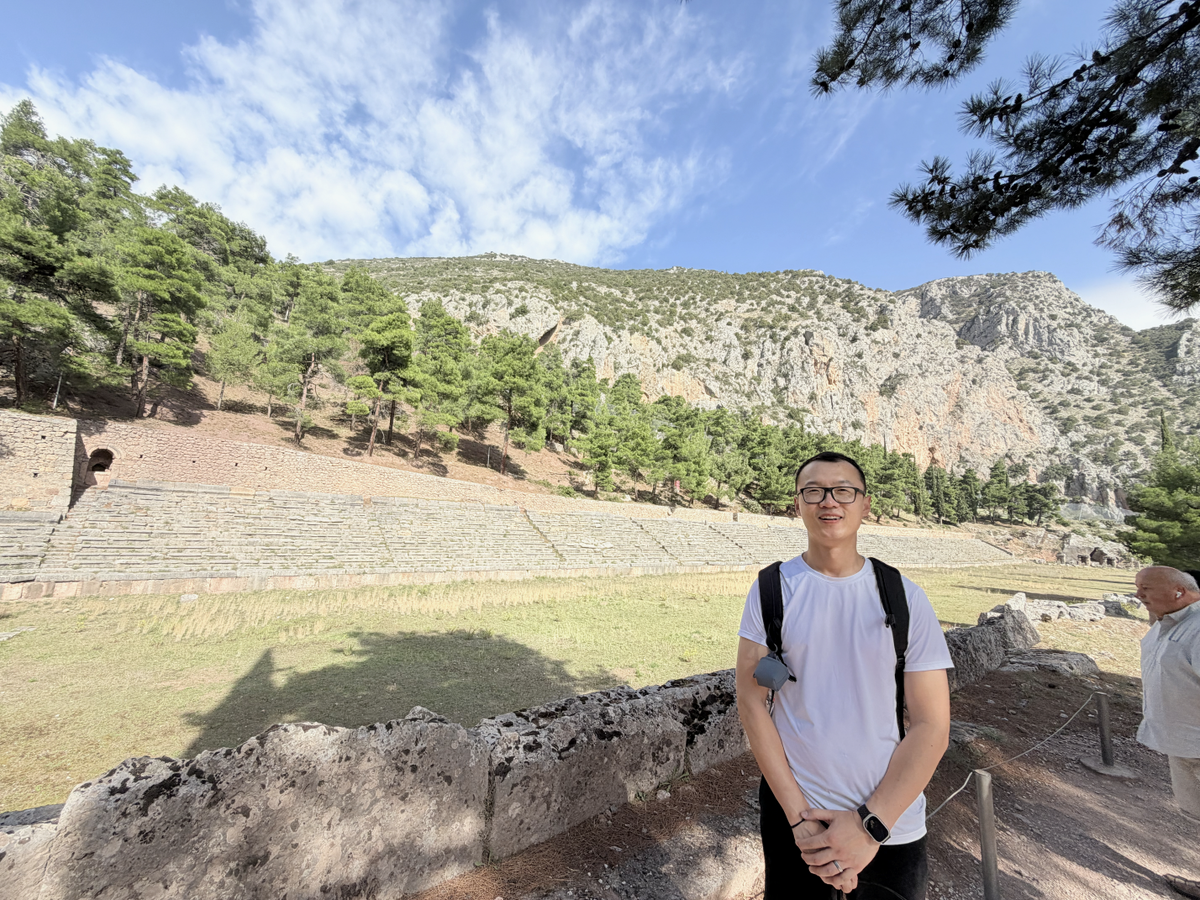
Eventually, we decided to continue toward the ancient stadium, which meant climbing even farther uphill. At one point, we could see people standing on a terrace well above us, and realizing that we were supposed to walk all the way up there was a little discouraging. But we'd already come this far, and curiosity got the better of us. When we finally reached the stadium area, I have to admit that it was somewhat underwhelming compared with the Panathenaic Stadium we'd visited in Athens. It was much smaller than we'd imagined, with a relatively narrow running track and stone seating arranged along the hillside. Some of the access was restricted, so we couldn't explore the entire structure, but we could still appreciate its layout and imagine athletes competing there during the Pythian Games. After all that climbing, though, I couldn't help thinking that the athletes must have been exhausted before their competitions even began.
As we started making our way back down, we had an unexpectedly lengthy conversation about why descending the mountain seemed harder than climbing it. Going uphill had felt relatively straightforward, but coming down required more careful footing, balance, and control, especially on the uneven stone paths. We began debating which muscles were responsible and whether the human body was simply better designed for climbing than descending. In reality, walking downhill places substantial demands on the leg muscles as they work to control the body's descent, but our immediate conclusion was somewhat less scientific: perhaps we were simply getting weak. Either way, the conversation provided some entertainment as we made our way down the same path we'd been so determined to climb.
There were also plenty of little openings, passages, and partially enclosed spaces among the ruins, which naturally made us think about how the girls would have reacted if they'd been there with us. We could easily imagine Ella trying to climb into every interesting opening she encountered, with Charlie following close behind, probably bumping her head because she still hasn't quite figured out that her head extends above her eyes. We joked that, in Charlie's understanding of the world, if her eyes can fit underneath something, the rest of her head should be able to follow. It was one of several moments during the trip when we found ourselves imagining the girls exploring these places, even though we'd deliberately planned this vacation as time for just the two of us.
Before leaving Delphi, we walked along the road to look more closely at the lower archaeological complex we'd noticed when we arrived. Part of the area, including the ancient Gymnasium, was closed for conservation and safety reasons, so we couldn't explore it from inside. But from our elevated position along the road, we had an excellent view of the foundations and terraces below. In some ways, I actually preferred seeing the ruins from above. When you're standing directly among ancient foundations, it's often difficult to understand what you're looking at because everything appears to be a collection of scattered stones. From a higher vantage point, however, the layout becomes much clearer. You can begin to distinguish the outlines of rooms, courtyards, and other structures, making it easier to imagine how the complex might once have functioned. It reminded me of something I'd been thinking about since our visit to the Ancient Agora: archaeological sites are fascinating, but without a little contextual information or a visual reconstruction, it can be surprisingly difficult to connect what remains today with the activities that once took place there.
By the time we'd finished exploring, it was shortly after one o'clock, and we still had another long drive ahead of us. We got back into the car and continued north toward Kastraki, the small village at the base of the Meteora rock formations. The first part of the drive involved winding mountain roads with frequent turns and changes in elevation, which demanded considerably more attention than the relatively straightforward highways we'd been expecting. Eventually, though, the terrain became flatter, the roads opened up, and driving became much easier. We settled into the journey, enjoying the changing scenery and occasionally stopping to admire something that caught our attention.
Somewhere along the way, we came across what turned out to be one of the most beautiful viewpoints of the entire trip. We noticed a roadside turnout where a couple of campers had parked, and something about the location made us curious enough to stop as well. There wasn't anything particularly remarkable about the parking area itself, but the view beyond it was magnificent. We were partway up a mountainside, looking out across an enormous valley framed by mountains on either side. Below us, agricultural fields stretched across the flatlands in a patchwork of greens and browns, gradually opening toward what appeared to be a broad bay or gulf in the distance. The landscape had an incredible sense of depth, with mountains, farmland, water, and sky all layered together. We hadn't planned to stop there, didn't know the name of the viewpoint, and probably wouldn't have noticed it if those other vehicles hadn't been parked nearby. Yet it became one of the most memorable discoveries of our trip. We took several photographs, none of which quite captured the view, and eventually continued driving, still talking about how beautiful it had been.
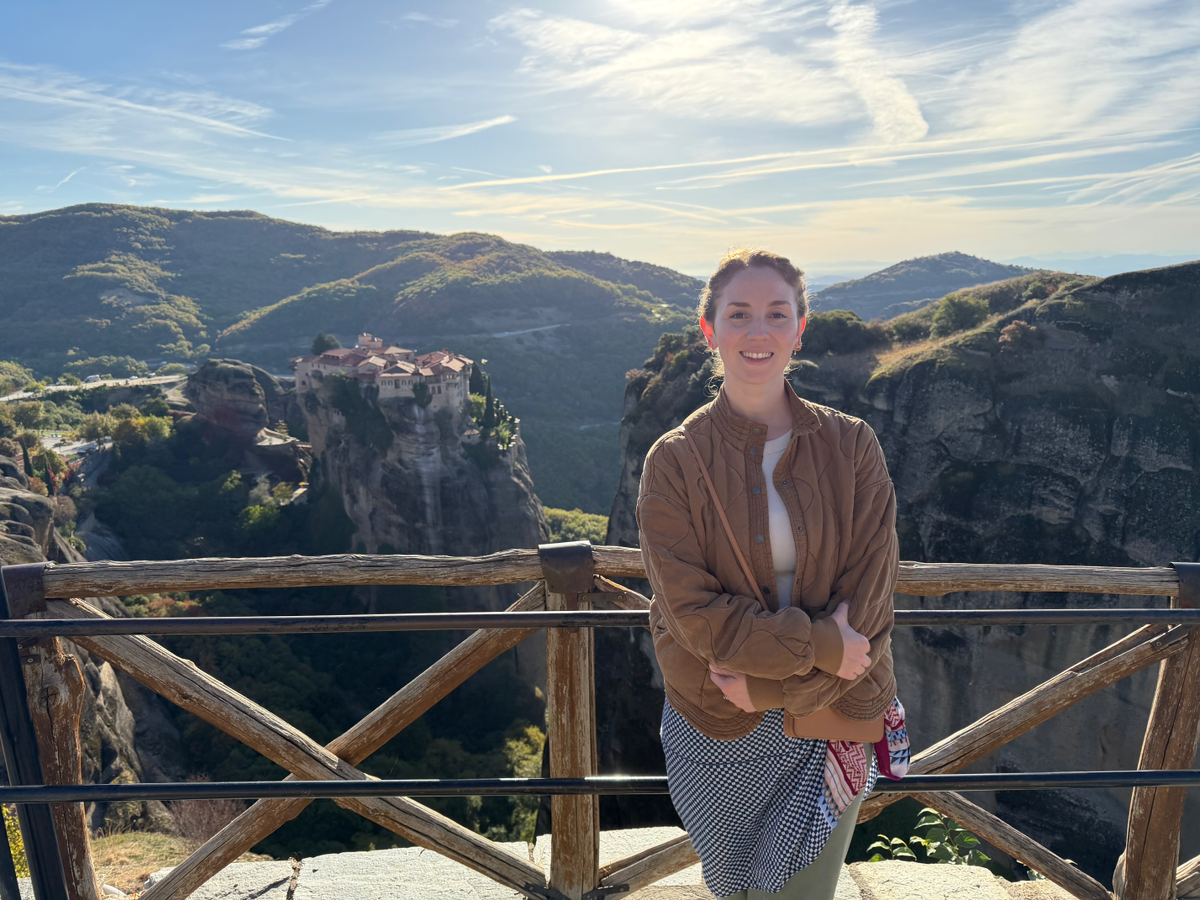
We arrived in Kastraki at approximately 3:30 in the afternoon, having booked our hotel while traveling. Fortunately, everything worked out well, and our room was ready when we checked in. The hotel itself was lovely, but what made it particularly memorable was the view from our balcony. We could look out over the village, with its houses and streets nestled beneath enormous rock formations rising almost vertically from the surrounding landscape. We'd seen photographs of Meteora before, but nothing had prepared us for how massive and unusual these formations actually were. Some looked like enormous stone pillars, while others formed broad, rounded towers with steep sides and surprisingly narrow summits. And perched on top of several of them were monasteries that seemed almost impossibly small against the surrounding rocks.
The name Meteora is often translated as "suspended in the air," which seemed particularly appropriate once we saw the monasteries in person. The rock formations themselves were created over immense geological timescales, through the deposition and subsequent erosion of ancient sediments, but what made the landscape truly extraordinary was the way people had adapted to it. Christian hermits began seeking isolation among these rocks centuries ago, and organized monastic communities eventually developed on some of the most inaccessible formations. Looking at the buildings from below, it was difficult to imagine how anyone could have constructed them, much less transported the supplies necessary to sustain daily life. We planned to visit one of the monasteries the following morning, but for now, we were more interested in experiencing the landscape from the outside.
After checking into the hotel, we found a little restaurant in Kastraki and settled in for a late lunch. We ordered moussaka and souvlaki, both of which were excellent. By this point, souvlaki had become something of a recurring feature of our vacation, but we certainly weren't complaining. There was something particularly enjoyable about eating in a small village after several days in Athens, especially with those extraordinary rocks rising above the surrounding buildings. The atmosphere felt quieter and more relaxed, and we were happy to take our time before heading back out to explore.
We then got into the car and began driving the scenic circuit through Meteora, following the winding road that connects the monasteries and panoramic viewpoints. This turned out to be one of the most visually impressive experiences of the entire vacation. Almost every turn revealed another extraordinary perspective, with enormous rock formations rising abruptly from the valley and monasteries perched on top of them. Some buildings seemed to emerge directly from the stone, while others occupied relatively small areas at the summit of towering pillars. We kept pulling over at designated viewpoints to take photographs, and every time we thought we'd found the best view, another appeared around the next bend.
We'd already encountered some remarkable scenery during the drive through central Greece, but Meteora was unlike anything else we'd seen. The contrast between the natural formations and the monasteries was particularly striking. The rocks themselves were impressive enough, but the presence of buildings on top gave them an entirely different sense of scale and made us wonder about the people who had chosen to live in such extraordinary isolation. We could also see why the area had become such a famous destination for photographers. Depending on the angle and the light, the same formation could look completely different, and the surrounding valleys provided an almost endless variety of backgrounds.
We eventually found a panoramic viewpoint where we could watch the sunset. The evening light gradually softened over the landscape, illuminating the enormous rocks and casting long shadows into the valleys below. After the somewhat disappointing sunset at Cape Sounion the previous evening, where clouds had prevented us from seeing the sun disappear completely, Meteora gave us the kind of scenery we'd been hoping for. We spent a good amount of time taking pictures and simply enjoying the view, although once again, it was difficult to capture the scale of what we were seeing. There was something almost surreal about standing on one enormous rock while looking across at several others, each with its own monastery seemingly suspended above the landscape.
After sunset, we continued driving along the monastery road and came across an entrance to one of the monasteries that had already closed for the day. We decided to walk a short distance along the approach path anyway and eventually found a large rock that offered another excellent place for photographs. We spent a little more time there, enjoying the quiet and taking advantage of the last remaining daylight before heading back toward Kastraki. By then, we'd driven around much of Meteora and seen the monasteries from several different perspectives, and we were beginning to feel that visiting one or two interiors the following morning would be enough. The landscape itself had already made the journey worthwhile.
On the way back to the hotel, we stopped at a small local grocery store, which ended up being an unexpectedly interesting part of the evening. It wasn't a tourist attraction or anything particularly remarkable, just a regular village shop where people bought their everyday necessities. But that was precisely what made it appealing. There were fresh vegetables, groceries, household supplies, clothing, and even tools, all packed into a relatively compact space. After spending several days visiting famous monuments and restaurants catering to tourists, it was refreshing to see something that seemed to be part of ordinary village life. We enjoyed looking around and imagining what it might be like to live somewhere like Kastraki, surrounded by such extraordinary scenery but still going about the same everyday routines as people anywhere else.
Back at the hotel, we finally decided to open the bottle of champagne that Conrad Athens had given us on our first day. We'd been carrying it with us, waiting for a good opportunity, and sitting beside the pool with a view of Meteora seemed like an excellent occasion. By then, it was completely dark outside, and the village lights were glowing below us. Some of the enormous rock formations were illuminated near their bases, revealing their silhouettes against the night sky. It was a beautiful scene, and after a long day of driving, hiking, and sightseeing, we were more than happy to sit there together, enjoy the champagne, and appreciate the surroundings without feeling compelled to go anywhere else.
There was something particularly memorable about seeing Meteora at different times of the day. We'd arrived in the afternoon, when the sunlight made the rock formations appear almost golden. We'd watched them change with the sunset, and now, sitting beside the pool, we could see their dark silhouettes towering above the village lights. It was difficult to imagine a more unusual setting, and I found myself thinking that we could easily have spent another day or two here simply enjoying the scenery and exploring the surrounding area at a slower pace.
Unfortunately, the evening wasn't entirely free of practical concerns. We still hadn't finalized our return flights to the United States, and since we needed to be home before returning to work on Monday, we couldn't leave that problem unresolved much longer. I spent a considerable amount of time searching through possible airlines, connections, and departure times, trying to find a reasonable way to get us home on Saturday. Eventually, we settled on United Airlines, purchasing tickets from Athens to Washington Dulles and onward to Hartford for approximately $540 per person. It wasn't particularly cheap, and we still hoped to get onto an earlier connection from Dulles, but at least we finally had a confirmed way home. Knowing that we'd arrive Saturday night and have Sunday to recover, spend time with the girls, and prepare for work made the expense a little easier to accept.
By the time we were ready for bed, I kept thinking about how consistently beautiful the scenery had been throughout the trip. We'd started in Athens, surrounded by ancient buildings and modern city life, then driven through mountains, agricultural valleys, and small villages before arriving somewhere as extraordinary as Meteora. Even the places we hadn't planned to visit, like that roadside overlook on the way north, had been memorable. The weather had also been unusually pleasant, with warm sunshine, cool shade, and remarkably little wind, making it comfortable to spend almost the entire day outdoors. We seemed to be repeating the same observation wherever we went: everything was just so beautiful, and often in ways we hadn't expected.
We'd left Athens that morning feeling tired and somewhat frustrated by the traffic, but ended the day sitting beneath the Meteora rocks with champagne, having visited one of the ancient world's most important religious sanctuaries and discovered some extraordinary landscapes along the way. It had been a long day, and certainly not the most relaxing, but it was exactly the kind of experience we'd hoped to have when we decided to venture beyond Athens. Tomorrow, we'd visit the monasteries before making our way back south, but for now, we were content to be in Kastraki, surrounded by those enormous rocks and still a little amazed by everything we'd managed to see.
What We Originally Planned
Thursday, October 22 — Beyond the City
Check out of Conrad Athens and decide between the mountains and the sea. The adventure was still pending, and the overnight hotel had not yet been chosen.
Corinth & Nafplio — Rent a car and drive toward the Peloponnese for Corinth, Nafplio, and coastal towns.
Delphi — Head northwest to explore Delphi and its mountain setting.
Meteora — Continue farther north toward the monasteries and extraordinary rock formations of Meteora.
Scenic road trip — Leave room for the route itself to be part of the day.
Day 4
Friday, October 23 · Meteora, Lake Vouliagmeni, and Athens
Friday morning was one of the few occasions during the trip when we both woke up feeling genuinely well rested. Before heading downstairs for breakfast, I stepped onto our hotel balcony in Kastraki to take another look at the enormous Meteora rock formations overlooking the village. We'd admired the same scenery the previous afternoon and again after dark, but seeing it in the early morning light was an entirely different experience. The rising sun gradually illuminated the rooftops and surrounding rocks, while the village below was still relatively quiet. I stood there for a while just taking it all in, thinking how fortunate we were to have found a hotel with such an extraordinary view. We'd only spent one night here, but I was already glad we'd decided to stay rather than attempt Meteora as a day trip from Athens.
After a fairly typical hotel breakfast, we packed up and headed out, stopping first for gasoline. The bill came to exactly €57, which struck us as rather expensive, although we wouldn't fully understand why until a conversation with our Hertz rental agent later in the trip. With the tank filled, we made our way back up the mountain toward Great Meteoron Monastery, the largest and oldest of the surviving monasteries in Meteora, and the one we'd decided was worth exploring from the inside.
We arrived a little before nine, deliberately early because we expected parking to become difficult once the tour buses started arriving. Fortunately, that turned out to be a good decision, as we managed to find a space very close to the entrance. A few small souvenir stands were already operating nearby, and I have to give the shopkeepers credit for being rather persuasive, because we somehow walked away with several refrigerator magnets before even entering the monastery. The morning air was noticeably chilly, so I changed into long pants, which turned out to be appropriate given the monastery's dress requirements. Visitors were expected to dress modestly, and women wearing trousers had to cover them with wrap skirts before entering. We then followed a stone stairway that first descended along the side of the rock before climbing back up toward the monastery entrance, an interesting arrangement that gave us an early appreciation of just how difficult this place must once have been to reach.
The doors opened promptly at 9:30, and after paying €5 each in cash, we entered the complex. We'd already learned a little about the monastery's history from listening to guides speaking to nearby tour groups. Great Meteoron's origins date to the fourteenth century, when Athanasios the Meteorite established a monastic community on this enormous rock. Religious hermits had been seeking solitude among the Meteora formations long before that, but over time, these isolated communities developed into an important center of Eastern Orthodox monastic life. Standing there, surrounded by enormous cliffs with the valley spread out far below us, I began to understand why someone seeking isolation might have chosen such an extraordinary location.
What struck me almost immediately was the sheer engineering challenge involved in building and maintaining a functioning monastery on top of a rock that, for much of its history, was nearly inaccessible. Today, we're fortunate to have stone stairways that make the climb manageable for most reasonably mobile visitors, but those routes came much later. Historically, the monks relied on ropes, baskets, nets, and pulley systems to transport people, food, supplies, and building materials up the cliffs. It's remarkable enough to imagine constructing such a building without modern equipment, but maintaining an entire community there, year after year, seems even more extraordinary. We saw some of the historical equipment associated with these systems, along with old kitchens, storage rooms, and a cellar where wine had once been made and stored. These were among my favorite parts of the visit because they offered glimpses into the practical realities of life in a place that otherwise seemed almost entirely removed from the ordinary world.
The isolation, of course, wasn't simply an inconvenience the monks had learned to tolerate; it was part of what they were seeking. We overheard one guide explaining that the daily lives of the monks revolve around a relatively simple rhythm of prayer and work, repeated day after day. I later read a little more about how monastic life here developed around spiritual discipline, communal responsibilities, and deliberate separation from many of the distractions of ordinary society. Looking around the complex, I could appreciate how the physical environment might support that way of life. The difficult journey creates a natural sense of separation, while the cliffs and surrounding mountains establish a boundary between the monastery and everything below it. It's one thing to read about people choosing solitude for religious reasons, but another to visit a place where that decision has been expressed so dramatically through architecture and geography.
I was also surprised by how immaculate everything looked. I'd expected a rather weathered collection of medieval buildings, perhaps with rough interiors and more obvious signs of age, but the areas open to visitors were extremely clean, orderly, and carefully maintained. Some sections almost looked new, which makes sense when you remember that these monasteries aren't simply historical monuments preserved for tourists. They're still functioning religious communities, and their buildings have been repaired, adapted, and maintained over generations. The layout was a little confusing at times, with rooms, courtyards, stairways, and terraces arranged around the irregular shape of the underlying rock, but that actually made it more interesting. Rather than trying to force a conventional building onto the site, the builders had adapted their architecture to whatever space was available. We were also aware that we were only seeing the portions open to visitors, while other areas remained reserved for the monks who continue to live there.
Perhaps what I appreciated most, though, was how peaceful the entire place felt. There were plenty of tourists, but most people seemed content to speak quietly, wander through the gardens, admire the architecture, and take in the extraordinary views. We rarely encountered the kind of noise or commotion that can make popular attractions feel overwhelming. Instead, there was a subdued atmosphere that seemed to encourage everyone to slow down, even if only temporarily. Looking out from one of the terraces, with the enormous rocks extending in every direction and the villages far below, I began to understand the appeal of being somewhere so removed from the ordinary rhythms of society. Even with visitors constantly coming and going, the monastery seemed to retain some of the quietness that had attracted its original inhabitants.
We finished exploring around 10:30, having gained a much richer appreciation of Meteora than we'd had from simply viewing the monasteries from the road the previous evening. Before leaving, we drove to Varlaam Monastery, which we'd spotted from Great Meteoron and knew was closed to visitors on Fridays. That was perfectly fine with us, since we'd already decided that one proper monastery visit would be enough. The parking area was relatively empty, and we found a large rock nearby that offered an excellent place for photographs. We spent a little more time enjoying the scenery, conscious that this would probably be our final opportunity to see these remarkable formations before returning south.
I later learned that Meteora once had considerably more monasteries than the six that remain active today. At its height, around two dozen monasteries had been established across the rock formations, although many gradually declined or were abandoned over the centuries. Political instability, warfare, changing economic circumstances, and dwindling monastic populations all contributed to the disappearance of some of these communities. Knowing that made the surviving monasteries seem even more remarkable, particularly when considering how much effort must go into preserving buildings in such difficult locations. We'd spent the previous evening admiring Meteora as an extraordinary natural landscape, and this morning we'd experienced it as a place shaped by centuries of human determination, ingenuity, and religious devotion. I felt that we'd seen enough to appreciate both sides of its character, although I certainly wouldn't mind returning someday.
With a few final photographs taken, we climbed back into the car and began the long drive toward Athens. We'd decided to make one more stop at Lake Vouliagmeni before our vacation came to an end. Two days earlier, we'd admired the lake from above during our Cape Sounion excursion and been disappointed that the tour didn't allow enough time for swimming, so we were determined to return. There was, however, one practical complication: I still needed proper swimming shorts. We'd considered buying a pair at Conrad earlier in the week, but the hotel was asking approximately €170 for what appeared to be a perfectly ordinary pair. I couldn't justify spending that much on swimwear, especially when I could probably find something equally useful for a fraction of the price. Instead, I'd made do with some basic sauna shorts provided by the hotel, although that hadn't led to much swimming because the indoor pool was so cold.
As we approached Athens, we drove around the Olympic sports complex, hoping to make a quick stop, but couldn't find anywhere convenient to park, so we continued to The Mall Athens. After several days surrounded by archaeological sites, mountain villages, and ancient architecture, being inside a modern shopping mall felt strangely familiar. There were the usual parking garages, escalators, international retailers, and people going about ordinary shopping trips, which could have been almost anywhere. We visited several stores before eventually finding a discounted pair of Nike shorts that seemed suitable for swimming and, more importantly, something I'd actually wear again afterward. They weren't particularly cheap, but at least they were substantially less expensive than the Conrad option, and I could finally stop thinking about buying swimming shorts.
Another forty or fifty minutes of driving brought us to Lake Vouliagmeni, where we arrived a little after four in the afternoon. The lake occupies a natural limestone basin near the coast, formed through the collapse of an underground cave system and replenished by thermal springs and seawater. The result is an unusual body of mineral-rich water that maintains a relatively stable temperature throughout the year. From above, we'd thought it looked like a wonderful place to spend several hours, with its clear water, rocky backdrop, comfortable loungers, and bar. This time, we finally got to go inside. After paying admission, we changed into our swimming clothes and found available chairs along one side of the lake. We also discovered that towels weren't included and would need to be purchased separately if we wanted them, but since we weren't planning to stay very long, we decided to manage without any.
I'd somehow convinced myself that swimming in a thermal lake would be similar to soaking in a warm bath, so the first contact with the water was a little surprising. It wasn't unpleasantly cold, but it was definitely cooler than I'd imagined, especially once we'd been standing in it for a while. After adjusting to the temperature, we began to enjoy the experience, particularly when the small fish we'd heard about during our previous visit started gathering around us. These little fish are known for nibbling at dead skin, and we could actually feel them approaching our feet and occasionally other parts of our bodies. Whether they were accomplishing anything useful was impossible to tell, but the sensation was unusual enough to make us giggle. There was something mildly absurd about having spent so much effort getting back to this beautiful lake, only to stand there being investigated by tiny fish.
Unfortunately, the afternoon sun kept disappearing behind the clouds, and without its warmth, the air began to feel noticeably cooler. We eventually got out of the water and realized that our decision not to bring or purchase towels hadn't been particularly clever. Standing around air-drying in the shade became uncomfortable fairly quickly, and we decided we'd had enough swimming for the day. Of course, almost immediately after we'd finished changing back into our clothes, the sun reappeared, as though it had been waiting for us to leave. The timing was impeccable, although by then we had little choice but to continue with our plans. We still needed to drive into Athens, check into our hotel, drop off the luggage, and return the rental car to Hertz by 8:30 that evening.
The drive back into the city was predictably slow, particularly as we joined the Friday evening rush-hour traffic. After spending so much time on relatively open highways and scenic mountain roads, being back among commuters was a reminder of why we'd avoided having a car during our first two days in Athens. We eventually reached our hotel, Moxy Athens City, unloaded our bags, and headed back out to return the car to Hertz, bringing our road trip to an official end. It was a relief to no longer worry about parking, navigating narrow streets, or making another deadline with the rental vehicle.
Moxy was quite different from Conrad, where we'd spent the first two nights of our vacation. I'd watched a video discussing how some of the newer hotel concepts deliberately simplify the traditional experience, combining functions that used to be separated and eliminating amenities that many guests rarely use. Moxy is a good example of that approach, with the reception desk doubling as a bar and rooms that make use of compact storage solutions, including hanging racks instead of conventional wardrobes. Everything you really need is there, just in a more streamlined arrangement. I can certainly appreciate the practicality of that approach, especially given how often I stay in hotels for work. When all I need is a clean, comfortable room for a quick overnight, I don't particularly care whether there's a traditional front desk or a full-sized closet. But on a vacation like this, I still prefer somewhere with a little more refinement and attention to detail, where the accommodations themselves contribute to the experience rather than simply provide somewhere to sleep. Conrad had offered that kind of atmosphere, along with the service and facilities we'd enjoyed during our stay, although naturally it came at a considerably higher price. For one final night before heading to the airport, however, Moxy was perfectly adequate, and there wasn't much reason to spend substantially more.
With the car returned and the practical matters finally behind us, we decided to spend our last evening walking through Plaka again. We'd visited this historic neighborhood several times during the trip, but it remained one of our favorite places to wander, particularly after dark. The narrow streets, outdoor restaurants, little shops, and steady movement of visitors created an atmosphere that was unmistakably tourist-oriented but nevertheless enjoyable. We also had some unfinished souvenir shopping to take care of, especially since we still wanted to bring home a few things for the girls.
On our first day in Athens, we'd seen a little bamboo flute in one of the souvenir shops and considered buying it for Charlie, but for whatever reason, we'd decided against it at the time. As the trip progressed, I started feeling a little guilty about leaving it behind, and we happened to be talking about it again while walking through Plaka that evening. Then, almost absurdly, we turned a corner and found ourselves standing in front of the very same shop. Neither of us had deliberately navigated back to it, and we certainly hadn't expected to recognize it among the many similar storefronts we'd passed during the week. But there it was, with the flute we'd been discussing, so naturally we went inside and bought it. It was one of those delightful little coincidences that happen when you're traveling without a particularly rigid agenda, and I was glad we'd had a second chance to pick up something we thought Charlie would enjoy.
I'd also been looking for a blue-and-white striped shirt throughout the trip, partly because I liked the style and partly because the colors felt so distinctly associated with Greece. The Greek flag, the blue sea, the whitewashed buildings, and the many blue accents we'd seen along the way had somehow made that combination feel like the perfect reminder of our vacation. Unfortunately, despite browsing quite a few shops, I never found a shirt that looked quite right. What I did eventually find, however, was a pair of blue-striped swimming shorts that I really liked.
The irony wasn't lost on us. After spending so much time searching for swim shorts, driving out of our way to The Mall Athens, and finally buying the Nike pair earlier that afternoon, here was a perfectly appealing alternative hanging in a little shop in Plaka. I couldn't help thinking how convenient it would have been to discover them a few days earlier. But then again, if we'd found them earlier, we probably wouldn't have made the detour to the mall or ended up with the Nike shorts, which I genuinely liked and expected to wear regularly. It's funny how these small decisions and coincidences shape a trip in ways that are impossible to anticipate. Sometimes what initially seems like an inconvenience leads to something worthwhile, and sometimes the thing you've been looking for appears only after you've stopped needing it.
Eventually, we found a restaurant with outdoor seating and settled in for our final dinner in Greece. We ordered lamb kebab and an assortment of appetizers, giving us another opportunity to sample the Greek dishes we'd come to enjoy over the past few days. The atmosphere was lively without feeling particularly rushed, with people eating, talking, and wandering through the streets around us. After dinner, we stopped for ice cream and continued browsing a few more shops, enjoying the neighborhood without much of a destination or schedule in mind.
By then, there wasn't really anything left we needed to see or accomplish. The Acropolis, the Ancient Agora, Cape Sounion, Delphi, Meteora, and Lake Vouliagmeni were all behind us, and the next morning we'd be heading to the airport for our flight home. It was a strange feeling because the trip had been relatively short but remarkably full. In only four days, we'd moved between ancient cities, religious sanctuaries, coastal landscapes, mountain villages, and modern urban life, often experiencing several very different aspects of Greece within a single day. We'd also discovered that some of our favorite memories came from things that weren't major attractions at all: a turtle crossing a road, children having PE in an Olympic stadium, a roadside viewpoint we hadn't planned to visit, a village grocery store, and a quiet glass of champagne beneath the Meteora rocks.
As we walked back to Moxy, I found myself thinking about how much Greece had surprised us. We'd come expecting beautiful scenery and important historical sites, and we'd certainly found both, but what stayed with us was the variety of experiences and the ease with which ancient history seemed to coexist with ordinary contemporary life. We hadn't followed every part of our itinerary, we'd made some questionable navigational decisions, and we'd spent an unreasonable amount of time solving relatively simple logistical problems, but none of that diminished the trip. If anything, those moments made it feel more personal and memorable. Tomorrow was our travel day, and although we were looking forward to seeing the girls and having Sunday to recover before work, neither of us was entirely ready for the vacation to end.
What We Originally Planned
Friday, October 23 — One More Adventure
Room for discovery. The plan was to fill Friday after choosing Thursday’s route and confirming the return flight.
Wherever the road takes us — Keep the day open for one more adventure based on where Thursday ended.
No hotel or activity reservation had been recorded for Friday night.
Reflections
Written during our flight home · Saturday, October 24
As we're sitting on our flight back to the United States, I've been thinking about how much we managed to experience in just a few days. We visited some extraordinary places, from the Acropolis and the Temple of Poseidon to Delphi and the monasteries of Meteora, but what continues to occupy my thoughts isn't necessarily the famous landmarks. It's the smaller observations we made along the way, the differences between how people live in Greece and what we're accustomed to back home, and the questions that emerged as we explored a country we knew relatively little about before arriving. Now that I'm squeezed into a rather compact economy seat with more than ten hours of flying ahead of me, I figure there's no better time to revisit some of those observations, do a little overdue research, and try to make sense of what we experienced.
One of the first things that caught my attention in Athens was the sheer number of motorcycles and scooters on the roads. They seemed to be everywhere, weaving between cars, slipping through narrow openings in traffic, and occasionally traveling at speeds that looked rather alarming from the sidewalk. At first, I couldn't imagine how anyone could feel comfortable riding like that in such a congested city, particularly when the distance between a motorcycle and the surrounding vehicles sometimes appeared to be measured in inches. We also noticed electric rental scooters scattered throughout Athens, offering yet another way to get around without a car. After spending more time in the city, however, the popularity of two-wheeled transportation began to make sense. The streets are crowded, parking is limited, and gasoline is expensive, so a motorcycle offers some obvious practical advantages, even if I still wouldn't feel particularly comfortable riding one through that traffic.
The cost of gasoline added another dimension to that observation. When we filled our rental car near Meteora, the bill came to exactly €57, which initially seemed rather expensive. Later, I asked our Hertz rental agent to help me decipher the receipt, since it was written entirely in Greek. He explained the breakdown as approximately €25 for the fuel itself and another €32 in taxes and other charges, which sounded almost unbelievable. I wondered whether gasoline was taxed similarly back home and we simply weren't accustomed to seeing it itemized. After looking into it, I found that while American gasoline prices do include federal and state taxes, those taxes account for a much smaller proportion of the final price. In Greece, taxes and levies make up roughly half of what drivers pay at the pump. Suddenly, the abundance of small motorcycles and economical cars seemed much less surprising.
Athens traffic itself was every bit as congested as what we've experienced in large American cities, particularly on Thursday morning when it took us what felt like an eternity just to get out of the metropolitan area on our way to Delphi. What surprised me, however, was how courteous many drivers seemed to be despite the congestion. We repeatedly noticed people allowing others to merge, giving way when appropriate, and generally accommodating surrounding vehicles without the confrontational behavior we sometimes encounter in American cities. Even the motorcycles, despite their seemingly chaotic movements, appeared to operate within a shared understanding of how traffic flowed. It certainly wasn't orderly in the conventional sense, but somehow everyone seemed to know what everyone else was doing.
This courtesy seemed to extend onto the highways as well. Once we were outside the immediate Athens area, drivers generally treated the leftmost lane as a passing lane rather than somewhere to remain indefinitely. Slower vehicles moved over after overtaking, and faster traffic passed without the unnecessary maneuvering that becomes common when someone occupies the passing lane for miles. I don't remember encountering a single particularly persistent left-lane blocker during our entire road trip, which is something I certainly can't say about driving in the United States.
One thing that did puzzle me was how frequently the speed limits changed, often with repeated signs reminding drivers of the restrictions, even when the road conditions seemed essentially unchanged. Yet we rarely saw police officers or obvious speed cameras, which made me wonder how consistently those limits were enforced. Apparently, Greece has been expanding its automated traffic-enforcement systems, so perhaps more was happening behind the scenes than we realized. Either way, while a few days of driving is hardly enough to generalize about an entire country's driving culture, our experience was overwhelmingly positive. It was a reminder that heavy traffic and aggressive driving aren't necessarily the same thing.
Once we left Athens and began exploring the countryside, we noticed another interesting difference: the age of the cars. There were many vehicles that looked as though they'd been on the road for decades, not carefully restored classics or collectible vintage automobiles, but ordinary cars still serving their original purpose. Small hatchbacks, older sedans, and practical work vehicles were common sights in the villages and along the rural roads. We saw a mixture of European and Asian brands in the city, although Mercedes seemed particularly common, ranging from personal vehicles and passenger vans to utility trucks used around the cities and villages. Even the taxis came in a surprisingly wide variety of makes and models, and we spotted a few Teslas operating as taxis in Athens. There was an interesting contrast between the older cars that had clearly been in service for years and the occasional brand-new electric vehicle moving through the same streets.
I later learned that Greece has one of the oldest passenger-car fleets in the European Union, with the average car approaching eighteen years of age. That made sense given what we'd seen, although it also prompted me to think about the economic circumstances behind it. Greece went through a prolonged financial crisis that affected employment, wages, and household purchasing power, and replacing a vehicle remains a substantial expense for many families. Cars that might have been traded in years earlier in the United States often continue serving their owners here. From our perspective as visitors, there was something charming about seeing these older vehicles driving through small villages, contributing to the distinctly European atmosphere we were enjoying. But I also recognize that what appears picturesque to a tourist may simply reflect the financial realities of everyday life. It's easy to romanticize something when you don't have to live with the circumstances behind it.
Another aspect of Athens that fascinated me was its enormous physical footprint. Standing on the Acropolis and looking out across the city, we could see buildings stretching toward the surrounding mountains and almost every direction of the horizon. Yet unlike New York, Chicago, or even parts of Boston, there was no prominent cluster of skyscrapers defining the skyline. Instead, Athens appeared to consist of an almost continuous expanse of relatively low- and mid-rise apartment buildings, with balconies extending across the facades and buildings packed closely together. Faye, our guide on the Cape Sounion excursion, explained that buildings weren't allowed to stand taller than the Acropolis, which sounded entirely reasonable given the historical significance of the monument and the desire to preserve its prominence.
I nerded out a little on this one, partly because Beijing has similar concerns about preserving the historical character and skyline around the Forbidden City. As it turns out, Faye's explanation was a useful simplification rather than a universal rule. Athens does have building-height restrictions, particularly around the historic center, where preserving views of the Acropolis has influenced urban planning for decades. But the city's distinctive appearance also has a lot to do with how rapidly it expanded after World War II. During the following decades, large numbers of people moved from rural Greece into Athens, and much of the housing demand was met through the construction of the multistory apartment buildings that now dominate the cityscape. There was even a distinctive development arrangement called antiparochi, in which landowners provided their property to developers in exchange for apartments in the completed buildings. I found that particularly interesting because, on one hand, it reminded me of redevelopment arrangements in China, where homeowners sometimes give up their original houses in exchange for apartments built on the same land. On the other hand, it helps explain why so much of Athens looks architecturally similar, with one apartment block blending almost seamlessly into the next. It's a city that grew rapidly and densely, but largely horizontally rather than vertically.
The population is substantial too, with roughly 3.8 million people living in the broader Attica region, which includes Athens and its surrounding municipalities. That's somewhat smaller than the population of Greater Boston, depending on how the metropolitan boundaries are defined, but the visual impression from the Acropolis made Athens feel enormous. Looking out over that seemingly endless urban landscape, I couldn't help wondering how efficiently people could travel from one side of the city to another. We had a good experience using the metro, particularly when arriving from the airport, but navigating the wider city by car seemed considerably less appealing. At the same time, I found something aesthetically pleasing about a city whose most important historical monument remains so prominent above the surrounding buildings. The Acropolis still commands the skyline in a way that would be difficult to achieve if it were surrounded by modern skyscrapers.
For all its size and congestion, Athens also had a surprisingly charming collection of animal residents. Cats seemed to be everywhere, wandering through neighborhoods, lounging around restaurants, and making themselves comfortable even at our hotel. Some were friendlier than others, but they all appeared perfectly accustomed to sharing their surroundings with people. We noticed dogs enjoying the same freedom, including a few at Delphi that had settled down right in front of the archaeological site's ticketing center, happily sunbathing while visitors walked around them. Pigeons were everywhere too, and at one bakery where we stopped for breakfast, one casually helped itself to the crumbs around us as though it were another regular customer. None of these encounters was particularly extraordinary on its own, but together they added a certain character to the places we visited. There was something endearing about how comfortably these animals seemed to coexist with everyone, going about their own routines amid the constant movement of the city.
The people we encountered were another highlight of the trip. With the exception of one rather unfriendly immigration officer when we first arrived, almost everyone we interacted with was welcoming, patient, and willing to help. Hotel employees, restaurant staff, shopkeepers, and the people we met in smaller towns generally made us feel comfortable, even when we were clearly unfamiliar with local customs. Greece is understandably accustomed to international visitors, and tourism plays an enormous role in its economy, something that was apparent as we heard all kinds of languages while strolling through the city's streets. I later learned that the industry directly supports roughly one in seven jobs, which helps explain how deeply tourism is woven into everyday commercial life. Still, I found myself wondering how I'd feel if my own neighborhood were constantly filled with tourists photographing buildings, crowding restaurants, and interrupting ordinary routines. In places like Plaka, where the streets are beautiful and the atmosphere is lively, it's easy for us as visitors to appreciate the experience without fully considering what it means for the people who actually live there.
That thought became more interesting after a conversation with our Hertz rental agent. He mentioned that there had been a demonstration in Athens on Wednesday, the same day our Cape Sounion tour operator unexpectedly changed our pickup location out of concern for possible road closures. At the time, it had simply been an inconvenience for us, resulting in a last-minute scramble to find the correct meeting point. According to the agent, however, housing affordability was among the issues provoking frustration, particularly for university students who moved to Athens for school and struggled to find somewhere affordable to live. He described students needing to find jobs just to cover rent and basic expenses, while suitable employment wasn't always easy to find. He was also rather critical of the government's response, which he felt had done too little to address the problem.
I became curious enough to look into the demonstration afterward and discovered that students and teachers had indeed been protesting in central Athens over education funding, wages, and rising living costs, with student housing among the concerns being raised. Some university students had even set up tents in Syntagma Square to draw attention to the difficulty of finding affordable accommodation. Having spent so many years in higher education myself, I found their concerns particularly meaningful. Pursuing an education already demands considerable time, effort, and personal commitment, and I can only imagine how much more difficult that becomes when something as fundamental as securing an affordable place to live is an ongoing struggle. Learning more about the demonstration also cast our own experience that afternoon in an entirely different light. While we were rushing through the city trying to catch a minibus to see an ancient temple, people nearby were protesting issues that directly affected their ability to study, work, and build a future. I couldn't help thinking about how differently the same afternoon must have felt depending on whether you were visiting Athens for a few days or trying to establish a life there.
Our Hertz agent also made a comment that stayed with me. He described Greece as a "Western country" that, in his opinion, didn't always feel like one in terms of living standards, economic opportunity, and the way institutions functioned. He was particularly frustrated by what he perceived as widespread corruption and government inefficiency. I wasn't entirely sure what to make of his observation, especially since Greece is clearly part of the Western political and cultural world and has played such a significant role in its history. But I don't think he was really questioning the country's identity. Rather, he seemed to be expressing frustration with the gap between what people might expect from a developed European country and the difficulties they encounter in everyday life. I looked into some of the issues he mentioned and found that concerns about housing, wages, and public institutions are indeed part of the broader conversation in Greece. Of course, one person's frustrations don't necessarily represent an entire country, and a few days of vacation certainly don't give us enough perspective to judge its politics or institutions. Still, his comments reminded me that the comfortable and welcoming Greece we were experiencing as tourists could coexist with genuine difficulties for the people who live there.
I've probably mentioned the weather a dozen times already, but it deserves another mention because it genuinely influenced how much we enjoyed the trip. Throughout our stay, daytime temperatures were generally somewhere between 65 and 75 degrees Fahrenheit, which felt nearly perfect to us after living in New England. It was warm enough to spend most of the day outdoors comfortably but cool enough that walking through cities and climbing hillsides didn't become unbearable. What impressed us most was the remarkable lack of wind. Whether we were standing above the Aegean Sea at Cape Sounion, exploring the mountains near Delphi, or looking across the extraordinary rock formations of Meteora, the air was often almost completely still. At times, it felt as though the entire country had been placed beneath an enormous glass dome, protected from the wind while still enjoying all the warmth and sunshine of the Mediterranean.
In the shade, it felt pleasantly cool, while stepping into direct sunlight provided just enough warmth to make everything comfortable. We frequently saw locals wearing jackets and additional layers while we were perfectly happy in lighter clothing, which made us wonder whether years of New England winters had permanently recalibrated our understanding of comfortable weather. Almost every local we spoke with told us that October was a particularly pleasant time to visit, since the intense summer heat had subsided while the Mediterranean climate still offered plenty of warmth and sunshine. We were probably fortunate with the unusually calm conditions, but it was difficult to imagine better weather for the kind of exploring we were doing.
We were also pleasantly surprised by how affordable many everyday expenses seemed. There were certainly tourist traps, particularly near major attractions, and some of the luxury hotel prices were difficult to justify. The €170 swim shorts at Conrad will probably remain one of my favorite examples. Outside those situations, however, we generally found dining and smaller purchases reasonably priced compared with what we'd expect at home. On our final morning, for example, we bought two breakfast sandwiches, several additional bakery items, a freshly squeezed mixed-fruit juice for me, and coffee for Marissa, and the entire purchase came to less than €17. It was exactly the kind of simple, good-quality breakfast that would likely cost substantially more in many American cities.
Our rental-car representative had also suggested that Greece could be an excellent place to live if your income came from another country, and based on our experience, I could certainly understand why. Someone earning a relatively strong American salary while spending part of the year in Greece might enjoy considerably more purchasing power, particularly for dining, everyday services, and certain housing markets. But after learning a little more about local wages, I began to appreciate how important that distinction is. Out of curiosity, I looked into what people working in professions similar to ours might earn in Greece, and the differences were striking. Airline pilots and hospital physicians here can earn substantially less than their counterparts in the United States, despite the extensive training, responsibility, and demanding schedules associated with both professions. It made me realize that what feels inexpensive to us when converting dollars into euros may not feel inexpensive at all to someone earning a local salary. A €17 breakfast might be an excellent bargain from our perspective, while a family living on Greek wages could experience the same prices very differently.
More than once, particularly while looking out over the coastline or enjoying the view from our hotel in Kastraki, we found ourselves imagining what it would be like to spend longer periods of time in Greece. The idea of owning a modest house overlooking the sea and spending a couple of months here each year became increasingly appealing. Being able to wake up to a coastal view, enjoy the sunshine, explore nearby towns, and escape part of the colder New England season sounds like a wonderful arrangement. Whether that dream would be practical is another question, but the fact that we were seriously entertaining it after only a few days says something about how much we enjoyed being here.
There is also something remarkable about how easily Greece combines experiences that would ordinarily require several different trips. In four days, we walked through the birthplace of the modern Olympic movement, explored ancient temples associated with some of the most influential ideas in Western civilization, visited a sanctuary where people once sought guidance from an oracle, drove through beautiful mountains and agricultural valleys, and stood inside a monastery built on top of an enormous rock. We also swam in a natural lake, wandered through village grocery stores, encountered turtles and parrots in the middle of Athens, and spent evenings enjoying food in historic neighborhoods. The range of experiences within a relatively small geographic area was extraordinary, and there were moments when we felt as though we'd entered an entirely different country simply by driving a couple of hours away from the capital.
Looking back, one thing I would do differently is spend more time learning about Greek history, mythology, and religion before arriving. We had a general understanding of the major landmarks, but there were several occasions when we found ourselves standing in front of an extraordinary structure without fully appreciating its significance. I knew who Athena, Apollo, and Poseidon were in broad terms, but I didn't know enough about the stories, rituals, or historical circumstances associated with their sanctuaries to make all the connections while we were there. The same was true at Delphi, where understanding the influence of the Oracle and the significance of the Pythian Games made the archaeological site considerably more interesting. At Meteora, learning about Eastern Orthodox monastic traditions and the reasons people deliberately sought such extreme isolation added another dimension to what might otherwise have been simply an impressive collection of buildings perched on rocks.
That experience reminded me that the value of visiting a historical site often depends partly on what we bring to it. A ruined foundation may appear to be nothing more than a collection of stones until you understand the activities, beliefs, and people associated with it. Once those connections become clearer, the landscape begins to tell a story. I still think some archaeological sites could do a better job providing visitors with visual reconstructions and accessible explanations, particularly for those who don't already possess a detailed understanding of the history. The Ancient Agora was a good example, where the reconstructed Stoa of Attalos gave us a much clearer impression of the original environment than the scattered foundations surrounding it. At the same time, I recognize that we could have prepared ourselves more thoroughly, and that even a little background knowledge would probably have made the discoveries more rewarding without turning the vacation into an academic exercise.
Even something as simple as encountering the Delphic sayings "Know thyself" and "Nothing in excess" gave us an opportunity to connect an ancient place with ideas that remain relevant today. I found it particularly interesting that visitors seeking divine guidance were confronted with principles encouraging self-awareness and moderation. Those ideas seem just as applicable to contemporary decisions as they were thousands of years ago, even if our own itinerary wasn't exactly an exercise in restraint. There was certainly some irony in reflecting on the importance of moderation while attempting to see as much of Greece as humanly possible in four days.
Would we recommend Greece to others? Absolutely, and without much hesitation. The food was excellent, the people were welcoming, the landscapes were extraordinary, and the historical and cultural richness of the country exceeded our expectations. I would particularly recommend exploring beyond Athens and the famous islands, because places like Delphi and Meteora gave us an entirely different appreciation for what Greece has to offer. I would also encourage people to leave some room for unplanned discoveries. Some of our most memorable experiences weren't on the itinerary at all, whether it was watching schoolchildren have PE at the Panathenaic Stadium, discovering an extraordinary roadside viewpoint between Delphi and Kastraki, or sitting outside with champagne while the illuminated Meteora rocks rose above the village.
As our flight carries us back toward the United States, I'm realizing that what made this trip special wasn't simply the number of places we managed to visit. It was the experience of discovering a country together, comparing what we saw with the lives we're accustomed to, asking questions, occasionally disagreeing, laughing at unexpected situations, and imagining what it might be like to return someday with more time and fewer obligations. We came away with beautiful photographs and a much greater appreciation for Greece, but also with a long list of things we'd like to understand better and places we'd still like to explore. For a vacation we'd been putting off for far too long, that feels like a pretty meaningful outcome, and I suspect this won't be our last trip to Greece.
What We Originally Planned
Saturday, October 24 — Until Next Time
Travel day. We wanted not to rush the goodbye.
The target return date was Saturday, but the return flight had not yet been chosen. Once booked, the plan was to add the departure point, airport instructions, and a comfortable buffer.